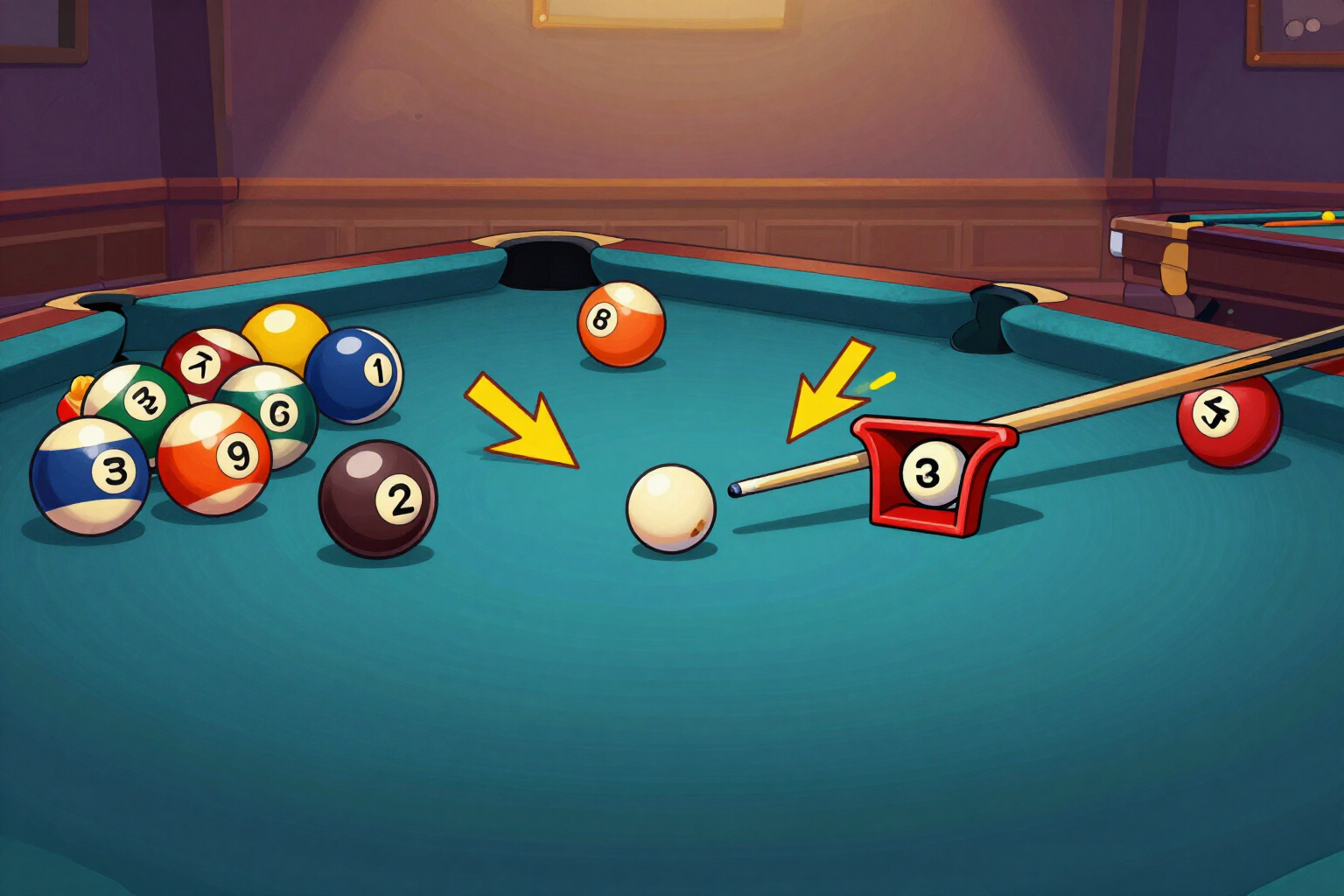
Foul alert in 8 Ball Pool: cue ball scratch detector
Before you shoot, see where the cue ball ends up: we draw its three paths with rail bounces and mark in red the pocket you'd scratch into.
You sink the ball and lose the match: the cue ball goes in right behind it and you hand the table to your opponent. It's the most repeated loss in the game, and it's not fixed by aiming better, it's fixed by knowing where the cue ball is heading.
You place the cue ball, the object ball and the pocket you're aiming for, and the trainer solves the entire impact. First it calculates the ghost ball and the cut angle; then it traces the cue ball's three real paths after the collision: the stun tangent, the forward follow and the draw. Each trajectory travels the distance matching the chosen power and bounces off up to two rails, just like on the table.
But the cue ball doesn't leave along a single line: it leaves as a fan. Between the tangent and the follow line we sample seven intermediate trajectories and track all of them; if any of them ends in a pocket, the alert triggers. That pocket is painted red on the table, with its ring and halo, and the readout shows the warning naming the dangerous pocket.
And it doesn't stop at the scare: it tells you what to do. If the problem is the follow shot, it suggests playing with draw or soft power; if the problem is the distance, it suggests lowering the power. The destination pocket itself also counts as a foul, because sinking the object ball and scratching the cue ball right behind it — the classic straight-shot scratch — still means losing your turn. While you drag the balls, an indicator on the table switches in real time between "Clean exit" and "Scratch risk!"
All of this is geometry calculated on your device: it doesn't overlay the game, doesn't read your screen, doesn't run during the match and doesn't query any game data. It's an offline trainer for before and after you play, not an in-match assistant.
Try Foul alert and cue ball path right here
Use it free without an account. If you want to save your result, you can sign up afterwards.
Save / Sign upBenefits of Foul alert and cue ball path
The cue ball's three paths, drawn
stun along the tangent, follow and draw on the table, with the distance proportional to the power you choose (soft, medium or hard) and bouncing off up to two rails.
Seven-sample dispersion cone
the real cue ball doesn't leave along a single line, it leaves as a fan. We track seven trajectories between the tangent and the follow line, not just the three named ones, so no scratch catches you by surprise.
The dangerous pocket, in red
the one about to swallow the cue ball is marked on the table with a red ring and halo, and the readout names it so you know exactly which one to avoid.
Concrete advice, not an empty warning
if it's the follow shot that scratches, it suggests draw or soft power; if it's the distance, it suggests lowering the power. Always with a suggested safe power.
It also counts your own pocket
sinking the object ball and scratching the cue ball behind it is the most common foul and the one guides forget most. Here it's factored into the calculation like any other.
Live indicator as you drag
the table switches between "Clean exit" and "Scratch risk!" the moment you move a ball, so you can feel your way to a safe position and watch it appear.
Scratch risk weighs on difficulty
the shot score rises when there's a danger of scratching, so you don't mistake an easy cut for a safe shot.
No sign-up and no cost
solving the shot, seeing the alert and downloading the diagram as a PNG requires no account and no AI. It's math, not a pay-per-shot service.
Don't lose another match by scratching
Place three balls and see if any path crosses a pocket. No account and no download.
In the features that use AI, responses are generated by artificial intelligence and are not a substitute for professional advice.