Amazon Shopping
Amazon Main Image Requirements for 2026: Background 255,255,255, 85% Frame, and Metadata Required for AI Photos
Team at AiToolsForAppsWritten with AI assistance17 min readIn summary
- Since 2026, Amazon reserves the right to replace the image of a listing —including those of registered trademarks— without notifying the seller if it believes that another seller's photo better meets the standard (analysis of the new image policy by EcomCrew, updated on February 16, 2026).
- The strict requirements for the main image are verifiable with a ruler and a pixel counter: RGB background 255,255,255, product occupying 85-100% of the frame, 1,000 px minimum on the longest side and 1,600-2,000 px for the zoom to look good, no text, no watermarks, and no accessories that do not belong in the box.
- A "nearly white" background (248 or 252) is indistinguishable to the eye and suspends pixel measurement: there is no published tolerance below 255.
- From July 22, 2026, any image, video, or A+ module featuring a photorealistic person entirely generated by AI must include the keyword
contains-synthetic-performerin thedc:subjectfield of the XMP before uploading it (notice collected by GeekSeller, August 3, 2026). - The product, on the other hand, is not generated: renders, CGI, and synthetic products are out of the main image. The photo must be of the actual object.
If you sell physical products on Seller Central, 2026 has been the year when Amazon's image standards ceased to be a guideline of good taste and became a measurement. The standard has hardly changed; what has changed is who checks it, how accurately, and what happens when it doesn't match. This article reviews what is verifiable —numbers, dates, and sources— and, at the end, explains where aiAmazon fits in, the suite of AI tools for Amazon sellers from AiToolsForApps, whose image study measures the submitted file and issues a compliance report with the actual percentage of white pixels and frame fill.

What has really changed in Amazon images in 2026?
The standard has not changed: the way it is applied has changed. The requirements for the main image (pure white, 85% fill, no text) have been published almost the same for years, and in the Seller Central forum, several sellers pointed out that the 2026 photographic standards reminder did not bring any new requirements compared to previous years, in the discussion about product photography standards in the official forum.
The new things are two, and both are from 2026:
- The automatic replacement of images. Amazon reserves the right to replace the photo of a listing, including those of registered trademarks, if it believes there is another that better meets the standard. This is noted by both EcomCrew and the 2026 image rules guide from ZonWizard, which summarizes it as the right to "replace the images of a listing (including those of registered trademarks)" when those of other sellers fit better with the platform's standards.
- The obligation to declare synthetic people. Since July 22, 2026, there is a mandatory metadata for photorealistic persons generated by AI. We will see this in detail below.
In addition, there is a change in method noted by industry consultants: the shift from reactive control —someone complains, Amazon reviews— to continuous scanning of the catalog with vision models that detect dirty edges, poorly cropped shadows, and backgrounds that are not truly white, according to the review of main image rules 2026 by Algofuse. This change in method is what turns a photo that has been live for three years into a removal overnight.
Amazon can change your main image without asking for your permission
This is the change with the most practical consequences of 2026: if your main image does not comply and another seller's image of the same ASIN does, Amazon can replace it with theirs on your listing. It is not a penalty or a warning: it is a silent substitution, and according to the cited sources, it also affects sellers with registered trademarks in Brand Registry.
The scenarios that, according to ZonWizard and EcomCrew, trigger the substitution are always the same and all are measurable defects:
- background that is not pure white in the main image;
- low resolution or blurry photo (below 1,000 px on the longest side);
- sparse image set, with unfilled gaps and no usage photos;
- product photographed inside its packaging;
- overlay of text, logos, or watermarks.
The reading for the seller is uncomfortable but simple: in a shared listing, the image standard is competitive. It is not enough to comply; it is advisable to comply better than the rest, because those who comply better are the ones who appear. And since images are the main driver of conversion —ZonWizard cites that half of Amazon buyers decide their purchase based on the photos— losing control of the main image is not an aesthetic problem.
The hard requirements for the main image, in a table
These are the parameters that can be checked about the file before uploading it, without interpreting anything. They repeat, with the same numbers, the 2026 guidelines and the Seller Central forum itself.
| Requirement | Required value | How to check |
|---|---|---|
| Background of the main image | Pure white RGB 255,255,255 | Pixel sampling of the perimeter |
| Product fill | 85-100 % of the frame | Product box against the canvas |
| Longest side | Minimum 1,000 px; recommended 1,600-2,000 px | Dimension metadata |
| Resolution | Minimum 72 dpi | File header |
| Format | JPEG preferred; PNG, TIFF, and GIF accepted (non-animated GIF) | Extension and header |
| Text, labels, borders, watermarks | Prohibited in the main image | Visual review |
| Accessories and props | Only what goes inside the box | Visual review |
| Cropped or repeated product | Prohibited: complete and only once | Visual review |
| Image gaps | Up to 9 per listing, 7 visible by default | Count in Seller Central |
Sources of the table: Seller Labs 2026 image specification guide, ZonWizard 2026 image rules and the product photography standards discussion from the Seller Central forum.
Honesty notice about a figure: there is disagreement among sources about the minimum pixel count. Algofuse claims that in 2026 the minimum for the longest side increased from 1,000 to 2,000 px, while Seller Labs, ZonWizard and the official forum continue to state 1,000 px as the minimum and 1,600+ as optimal. If you deliver 2,000 × 2,000 px, the disagreement no longer affects you.
Why does a white 248 pass on screen and fail in measurement?
Because the eye compares and the software measures. A background at 248,248,248 or 252,252,252 is visually indistinguishable from pure white on a phone with medium brightness, but in a pixel check it is simply "not 255": there is no published tolerance, and the value all sources ask for is exact, RGB 255,255,255. Algofuse describes exactly that: values previously tolerated like 252 now trigger automatic detection.
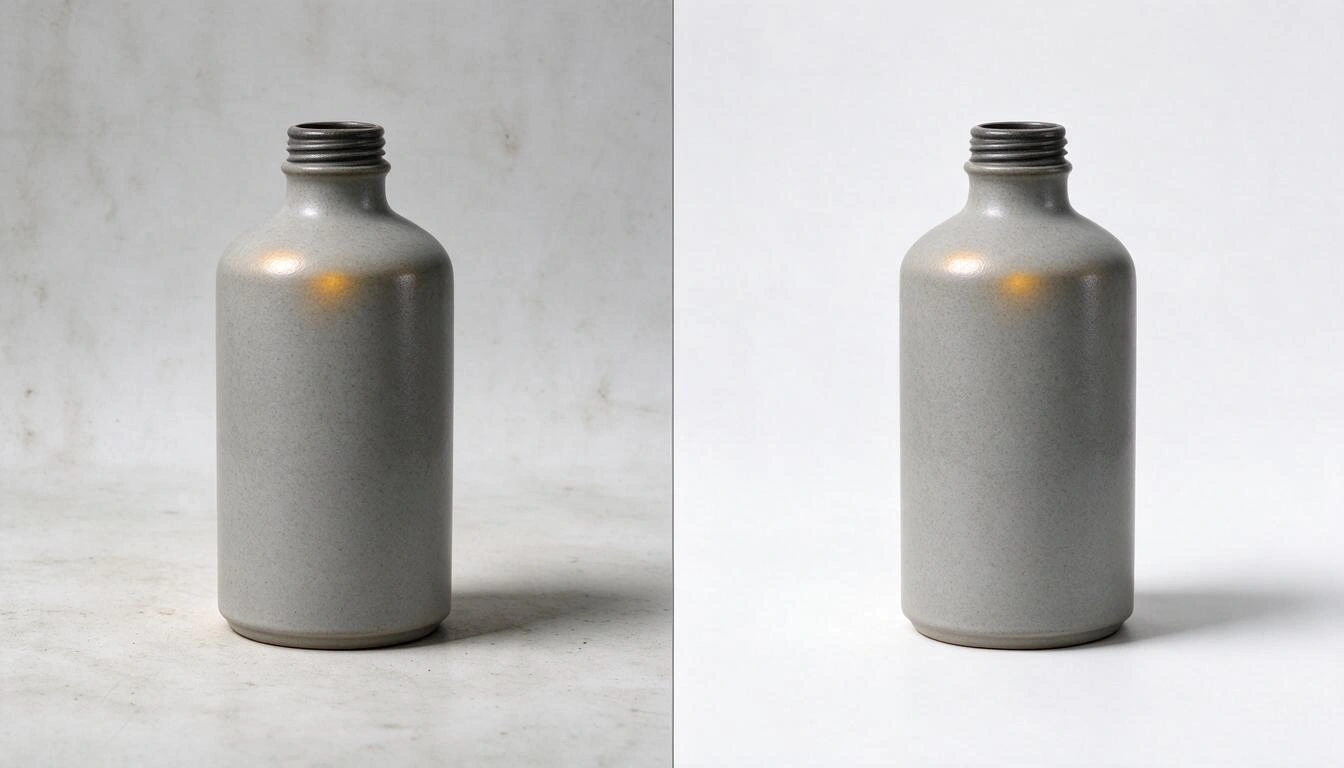
There are three common ways to lose the 255 without realizing it:
- Real studio lighting. A white paper background unevenly lit gives 250 in one corner and 255 in the center. What matters is the complete perimeter, not the center.
- Hand cropping with the brush. The anti-aliasing of the edge leaves a halo of gray pixels that, besides not being 255, reveals the cropping to an edge detector.
- JPEG compression. And this is the most silent trap: even if your canvas is pure 255, aggressive quality JPEG introduces artifacts around the product's contour and dirties the neighboring pixels. You can have a perfect PNG and a suspended JPEG from the same file.
The operational consequence is that the white must be verified on the final delivered file, not on the editing document. If you measure in Photoshop before exporting, you are measuring something that is not what Amazon will receive.
The 85 % of the frame: what is measured exactly
The area occupied by the product within the canvas is measured, not its height. The requirement is that the product fills 85-100 % of the frame, which in practice means that the white margins around the object must be narrow and similar to each other. A small product centered on a large canvas is the most common failure, and according to Algofuse there is no longer any tolerance margin for excess white in small items.
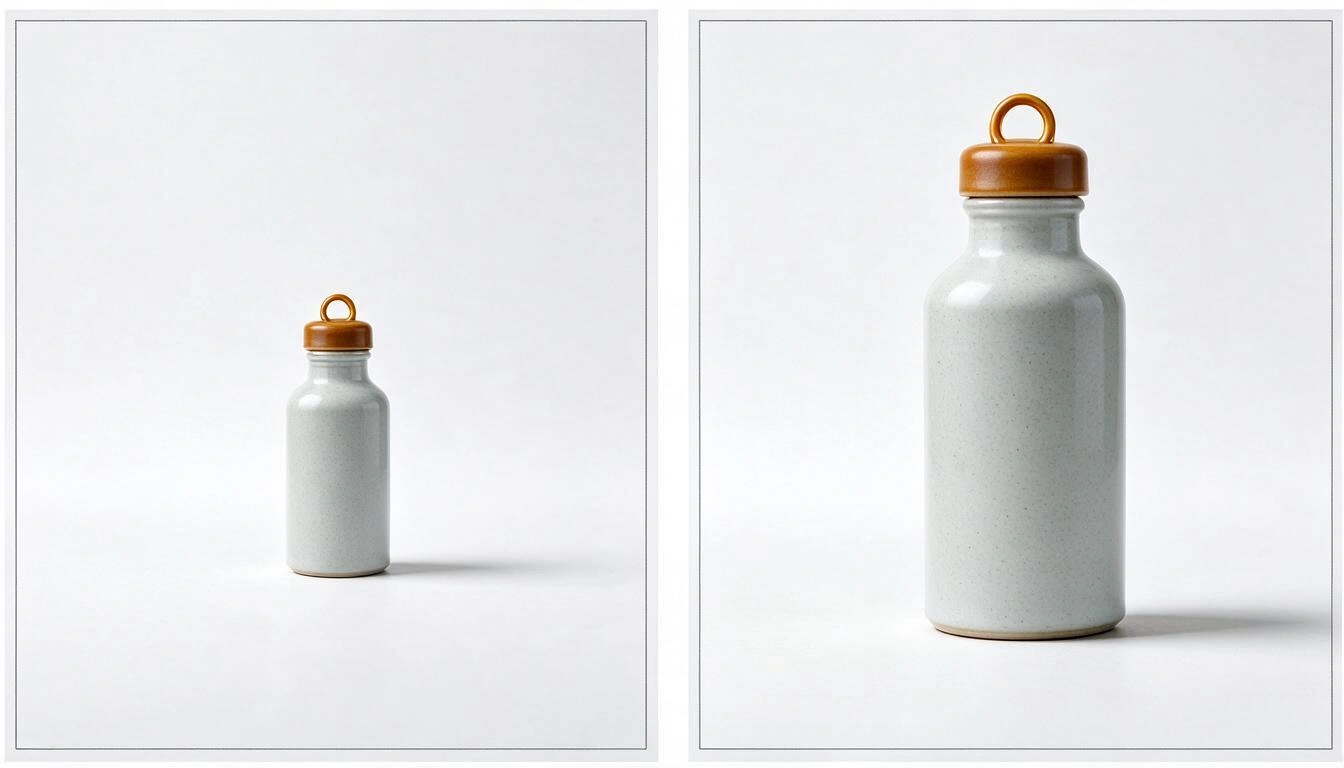
Two nuances that are worth clarifying:
- The 85 % is not "cutting it close". The product must appear complete and without cropping. Reaching 85 % by cropping a corner replaces one non-compliance with another.
- The framing depends on the shape of the product. An elongated object (a bottle, a tripod) reaches the vertical limit sooner and leaves space on the sides; a square object fills better. That’s why the reasonable working figure is a target slightly above the minimum —around 86 %— instead of pushing for the exact 85, which leaves the file on the edge of failure.
Additionally, there are specific rules by category that change the entire framing, according to Algofuse's review: in adult clothing a standing human model is required and the ghost mannequin is rejected; in children's clothing a top-down shot of the stretched garment is requested and no child models are allowed; in food, the label on the packaging must be clearly readable. Before measuring the 85 %, it is advisable to know which category you are in.
What does the metadata "contains-synthetic-performer" require and from whom?
It requires declaring, in the metadata of the file itself, that a photorealistic person in the image or video is entirely generated by AI. Starting from July 22, 2026, Amazon requires adding the exact keyword contains-synthetic-performer to the dc:subject field of the XMP —with a metadata editor compatible with IPTC— before uploading the content to the listing or A+ content, in all its stores worldwide, according to the notice reported by GeekSeller and the breakdown of Masonry's AI image rule.
The phrase is literal: all in lowercase and with hyphens between the three words. And the scope is narrower than it seems:
| Case | Does it need the metadata? |
|---|---|
| Photorealistic person entirely generated by AI | Yes |
| Real person, even if the photo is retouched with AI | No |
| Image without people (only product) | No |
| Fictional character, video game, or animation | No |
| Person clearly not photorealistic (illustration, drawing) | No |
The origin of the rule is not aesthetic; it is legal. Article 396-b of the General Business Law of New York, in effect since June 9, 2026, requires anyone producing a commercial advertisement with actual knowledge that it contains a synthetic performer to declare it visibly, with civil penalties of $1,000 for the first violation and $5,000 for each subsequent one, according to the analysis of the synthetic performer law published on Lexology and the notice prior to the entry into force from Reed Smith. Amazon has extended the requirement to everyone, not just New York, to avoid having two standards.
What is important for those selling physical products is the other half of the rule, the one that is not declared: the product cannot be generated. Masonry and Algofuse agree that enhancement with AI that does not alter the product —removing the background, correcting color, cleaning dust— is acceptable without declaring anything, while a representation of the product substantially generated or altered by AI requires declaration, and a fully synthetic main image, without real photography behind it, is subject to removal and account-level infringement. In other words: AI can clean your photo; it cannot invent the product for you.
What happens if the image does not comply?
The consequence is not an email requesting a correction, but the loss of visibility while the procedures are underway. According to the enforcement review by Algofuse, continuous scanning marks the violation around 7 days, and typical removal leaves the listing out of search for 24 to 48 hours, with automatic pausing of PPC campaigns, loss of the Buy Box, and a positioning damage that takes weeks to recover. Masonry cites the criterion of the policy itself: if there is no main image that meets the requirements, the listing may be removed from search results.
The real cost, therefore, is not redoing the photo: it is the gap in the sales history and the advertising expenditure that must be reinvested to recover the position. That is why the check must be done before the upload, not after the notice.
How to Have the Defendable Photo Before Uploading It
A "defendable" photo is one that you can explain, with numbers, why it meets the criteria. The flow that the sector is adopting in 2026 has five steps, and none depend on luck:
- Photograph the actual product. With a camera or a mobile phone, but the physical object. It is the only step that cannot be delegated to software.
- Isolate the product and set the background to 255,255,255 by code, not by eye. Programmatic filling guarantees the exact value; the brush does not.
- Frame the target, with some margin. Square canvas of 2,000 × 2,000 px and a fill slightly above 85% to avoid being on the edge.
- Add contact shadow only if the product is almost white. Without it, a white product on white appears to be floating; with poorly done shadow, you invade the perimeter and lose the 255. It is a balance that should be resolved deterministically and reversed if it touches the edge.
- Measure the final binary and save the report. Percentage of 255 pixels in the perimeter, frame fill, dimensions, weight, the four margins. If the JPEG soils the white, re-deliver in lossless PNG.
That last step is what distinguishes a pretty photo from a verified photo, and it is exactly the gap that aiAmazon covers, the suite of AiToolsForApps for those selling on Seller Central: its image studio isolates the product and forces the background to 255,255,255, frames in a canvas of 2,000 × 2,000 px with a fill target of 86% (valid range 85-90%), adds the contact shadow deterministically and reverses it alone if it invades the perimeter, and then re-reads the delivered file to issue a compliance report with the percentage of 255 pixels, side and area fill, pixels, kilobytes, the four margins, and a verdict of compliant or non-compliant. If the JPEG has soiled the white, re-deliver in lossless PNG. There is also a pre-checklist of main image requirements with nine items, five of which are automatically verifiable —white 255, 85% frame, 2,000 px, square canvas, and format—, which works for free and without registration.
Regarding the AI part, it is important to be precise: aiAmazon does not write the metadata contains-synthetic-performer for you —that is done with an IPTC-compatible editor—, but its design line goes in the opposite direction to the problem: the product is never generated by AI. In ambient scenes, the object is cut out from your own photograph, and the AI only paints the decor, and the exported package labels each file as a real product with AI-generated background. That is to say, you do not need to declare a synthetic performer because there is none.
Frequently Asked Questions
Does Amazon accept a white background 254,254,254?
There is no published tolerance: all sources for 2026 require exact RGB 255,255,255 for the main image, and Algofuse describes that nearby values like 252 trigger automatic detection. Since the cost of leaving it exact is zero, there is no reason to gamble on a 254.
How many pixels does the image need to have for zoom to activate?
The minimum reported by Seller Labs and the Seller Central forum is 1,000 px on the longer side, with 1,600 px or more as the optimal value and 2,000 × 2,000 px as the recommended standard. Uploading more than 2,000 px hardly adds anything, because the zoom viewer does not exploit that additional resolution.
Can I use an AI-generated image as the main image on Amazon?
No, if what is generated is the product. Renders, CGI, and substantially AI-generated representations of the product are outside of the main image, and a completely synthetic main image is subject to suppression and account infringement, according to Masonry and Algofuse. AI retouching that does not alter the product —cropping the background, correcting color— is acceptable.
Do I have to put the metadata contains-synthetic-performer on all my photos?
No. Only on images, videos, and A+ modules that show a photorealistic person entirely generated by AI. If your photos are only of the product, or the person is real even if retouched, or the character is not photorealistic, it does not apply, according to Masonry's breakdown.
Can Amazon replace my image if I have a trademark?
According to EcomCrew's analysis and the ZonWizard guide, the policy also applies to trademark listings when Amazon considers that better images are available. The practical defense is to meet the standard better than anyone and fill all image gaps.
How do I know if my photo meets the requirements before uploading it?
By measuring it against the final file: sample the pixels of the perimeter to confirm the 255, calculate the product box against the canvas for the fill, and check dimensions and format in the header. This is what the aiAmazon compliance report does, which provides those figures and a verdict instead of a printout.
How many images should I upload per listing?
Up to nine slots are available and seven are shown by default on desktop, according to Seller Labs. Leaving empty slots is one of the scenarios that ZonWizard points out as a trigger for image replacement, so filling them with usage photos, details, and size comparisons is both defense and conversion at the same time.
A standard that is measured, checked before uploading
The summary of 2026 can be encapsulated in one sentence: Amazon's image rules have not become stricter, they have become measurable. And when a requirement is measurable, the only comfortable position is to have the number before the algorithm: 255 on the perimeter, 85% or more of frame, 2,000 px on the side, zero text, zero props, and a photo of the real product. If you also work with AI-generated people in secondary, video, or A+, the metadata contains-synthetic-performer in dc:subject has been part of the work since July 2026.
For the part that can be automated without losing control, aiAmazon, from AiToolsForApps, is built just with that criterion: forced 255,255,255 background, 86% framing, and a measured compliance report on the submitted file, plus the rest of the listing work —title by category, five bullet points, description, and search terms counted in real bytes— in the same place. An independent tool, with no relation to Amazon.
Measure your main image before uploading it to Seller Central: aiAmazon forces the background to 255,255,255, frames the product at 86% on a 2000 × 2000 px canvas, and provides a compliance report with figures and verdict. The checklist of requirements works for free and without registration.
Measure your main image before uploading it to Seller Central: aiAmazon forces the background to 255,255,255, frames the product at 86% on a 2000 × 2000 px canvas, and provides a compliance report with figures and verdict. The checklist of requirements works for free and without registration.Keep reading
View all articles →
How to Optimize Your Amazon Listing for Rufus and COSMO in 2026: The 5 Bullet Points That AI Understands

Broken Geode in Geometry Dash 2.2091: which mods are not working and how to keep creating
DLS 27 in December 2026: what is confirmed, what is not, and what happens to your club, your squad and your kits when you update