8 Ball Pool
Ocean Drive Heist Season in 8 Ball Pool: what to train before hitting the high-stakes tables
Team at AiToolsForAppsWritten with AI assistance15 min readIn summary
- The Ocean Drive Heist season of 8 Ball Pool started on November 4, 2026 and its schedule extends until November 25 (with token redemption until December 2), according to the official 8 Ball Pool site consulted on November 14, 2026.
- The season's claim is the high-stakes matches: events and rankings push the player to high-entry tables before mastering what decides those matches.
- It’s not the cues: it’s four geometric skills — cue ball stop shot (90° rule), cut by ball fraction (half ball = 30°), cushions and mirror kicks with their real margin, and not sinking the cue ball after impact.
- The first three are provable math, identical on mobile and on a real table: the tangent is perpendicular to the center line and, with the cue ball rolling, the deviation is around 30° between quarter and three-quarters of a ball (Dr. Dave Alciatore).
- Train with numbers, not feelings: sets of 10 attempts per exercise, recorded percentage, and difficulty that only increases when the percentage holds.
Each new season of 8 Ball Pool repeats the same cycle: the event arrives, the cues arrive, the ranking arrives, and thousands of players who comfortably won at cheap tables jump three levels at once to chase rewards. Two weeks later, they have burned through the coin bank and the conclusion they draw is that they need a better cue. It’s almost never that. This article reviews what really changed in the game in November 2026 and what four things should be measured before sitting at an expensive table — and, if you want to train them with numbers in front of you, the angle and cushion calculator for 8 Ball Pool from AiToolsForApps does exactly that: it draws the geometry of the shot and gives you the workbook to note it down.
What is the Ocean Drive Heist season and when does it end?
Ocean Drive Heist is the themed season that Miniclip launched in 8 Ball Pool on November 4, 2026, with a schedule that the official site sets from November 4 to 25 and open redemptions until December 2, 2026. Progress is made by playing matches, completing missions, and opening boxes from the Heist Cue Collection, and the rewards are cues, avatars, animated frames, emotes, and stickers, plus an exclusive cup associated with the ranking.
The public schedule, according to the season page on the official site (consulted on November 14, 2026):
| Block | Dates (2026) | What it requires |
|---|---|---|
| Ocean Drive Heist Season | November 4 – 25 | Play matches and progress the collection |
| Missions (Quests) | November 16 – 25 | Exclusive animated tokens and avatars |
| Showdown / ranking | November 22 – 25 | Climb the leaderboard |
| Token redemption | until December 2 | Exchange tokens for rewards |
It’s not the only novelty of the month. The 8 Ball Pool news channel also published the viewing of live matches with the Cheers feature (November 7, 2026), the Bluffing cue set under the slogan "Raise the Stakes" (November 9), and a table ring for Friday the 13th (November 13). On the technical side, branch 56.3x is the current one: Uptodown dates version 56.35.0 on November 9, 2026, and the 8 Ball Pool listing in the App Store shows that same version, publisher Miniclip SA, 4.8 out of 5 with 4.8 million ratings and a 13+ rating (consulted on November 14, 2026). On Google Play the listing exceeds 1 billion downloads.
Why does a season make you lose coins?
Because the season's design rewards volume and escalation, and the game's economy punishes exactly that when your technique hasn't improved with the table. 8 Ball Pool operates with a coin economy where each table has its entry fee and there are different levels of competition (Wikipedia): leveling up multiplies the entry fee, not your success percentage.
The arithmetic is unpleasant and very simple. If at your regular table you win 6 out of 10 matches, you are profitable. That same rate, at a table whose entry is ten times higher and where the average opponent misses less, easily falls below 5 out of 10 — and with 5 out of 10, the game is a tax on your time. The event doesn’t make you a worse player: it changes the denominator.
| Situation | Win rate | Result over 100 matches |
|---|---|---|
| Comfortable table, opponent at your level | 6 out of 10 | Growing bank, slow but real progress |
| Expensive table for the event, same technique | 4–5 out of 10 | Net loss, even if you claim rewards |
| Expensive table with the four skills measured | 5.5–6 out of 10 | Becomes profitable again |
The figures in the last two rows are illustrative, not measured: no one publishes win rates by table. What is known is the direction — the entry fee jumps suddenly and your technique does not.
What is the number one skill: where does the cue ball stop?
Controlling the cue ball's stopping point. It is the first because all the matches that are lost "due to bad luck" are actually lost because a cue ball ended up where it was not useful. And there is an exact rule: on a stun shot, with no forward or backward spin, the cue ball exits along the tangent line, perpendicular to the direction taken by the object ball — it is the 90° rule, described by David Alciatore in his illustrated articles for Billiards Digest.
From there, there are only two variants that matter:
- Rolling cue ball (follow). With natural follow, the cue ball deviates about 30° from its initial line over a wide range of cuts, approximately between one-quarter and three-quarters of a ball. This is called the 30° rule (Dr. Dave, where the cue ball goes).
- Draw. With good draw and cut angles below about 40°, the cue ball exits to the other side, and the usual reference is the triple angle system (trisect), according to the same source.
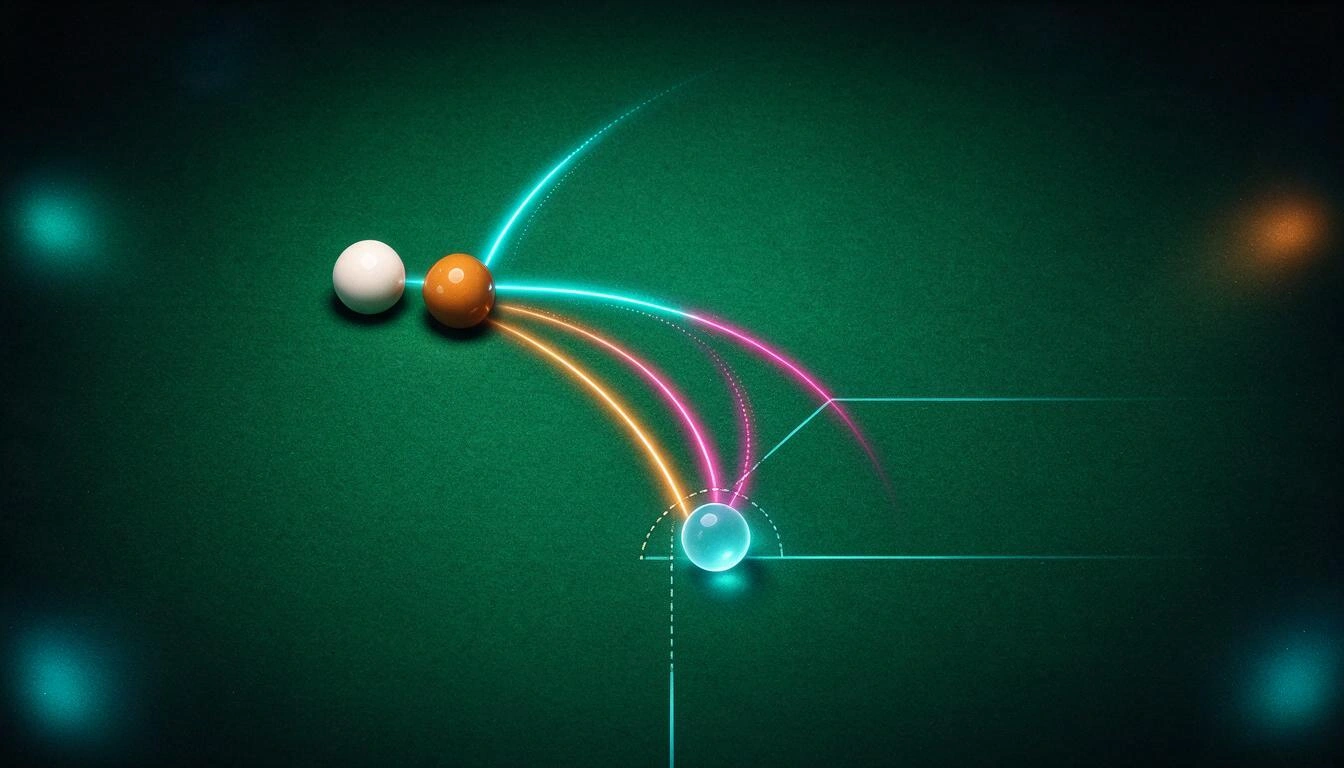
What is useful to memorize in table form:
| Shot | Cue ball exit | Range where the rule is reliable |
|---|---|---|
| Stun (stun) | Tangent line, at 90° to the object | Any cut |
| Follow (follow) | ~30° relative to the initial line | From 1/4 to 3/4 of a ball |
| Draw (draw) | To the other side; ~3× the cut angle | Cuts below ~40° |
All these rules need adjustment for speed and cloth condition, as the source itself warns. In the digital version, the cloth is constant, which works in your favor: the adjustment you learn is reproducible from game to game.
How do you read the cut angle without guessing?
By ball fraction: you look at how much the cue ball overlaps the object ball at the moment of contact, and that overlap translates directly into degrees of cut. The anchor of the system is half a ball = 30° of cut, the reference point against which all other angles are judged; it is the fractional aiming method that Alciatore develops in "Fractional-Ball Aiming" and to which he dedicated a whole article in "Half-Ball Hit Magic".
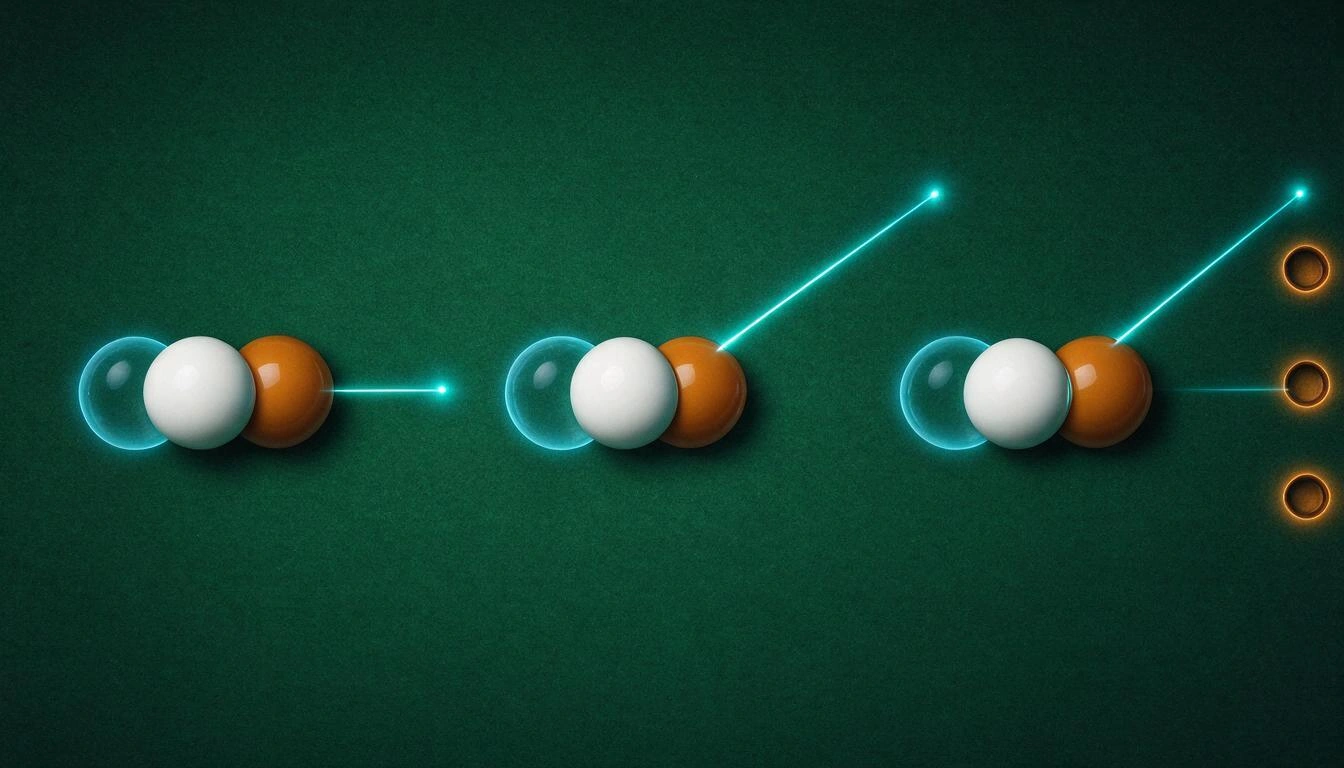
The geometric correspondence between fraction and degrees (the overlap equals 1 − sine of the cut angle), with the values used in the fractional aiming lessons and the cut angle estimation guide:
| Ball fraction | Approximate overlap | Cut angle |
|---|---|---|
| Full ball | 100 % | 0° (straight shot) |
| Three-quarters | 75 % | ≈ 14.5° |
| Half ball | 50 % | 30° |
| Quarter ball | 25 % | ≈ 48.6° |
| Eighth ball | 12.5 % | ≈ 61° |
| Thin cut | ~3 % | ≈ 75° |
Two practical consequences. The first: the jump from half a ball to a quarter ball is 18 degrees, so "a little thinner" is not an instruction, it's a lottery — you need to name the fraction. The second: past 70°, the margin collapses and the shot stops being a reasonable option; from there, the correct play is almost always a defensive one, not a miracle.
Are banks and kicks calculated or intuited?
They are calculated, and the base method is the mirror: you imagine the rail as a mirror, reflect the object to the other side, and aim at that imaginary point, reading the position with the diamonds on the rails. This is explained by both the World Pool-Billiard Association and the PoolDawg guide on banks and kicks.
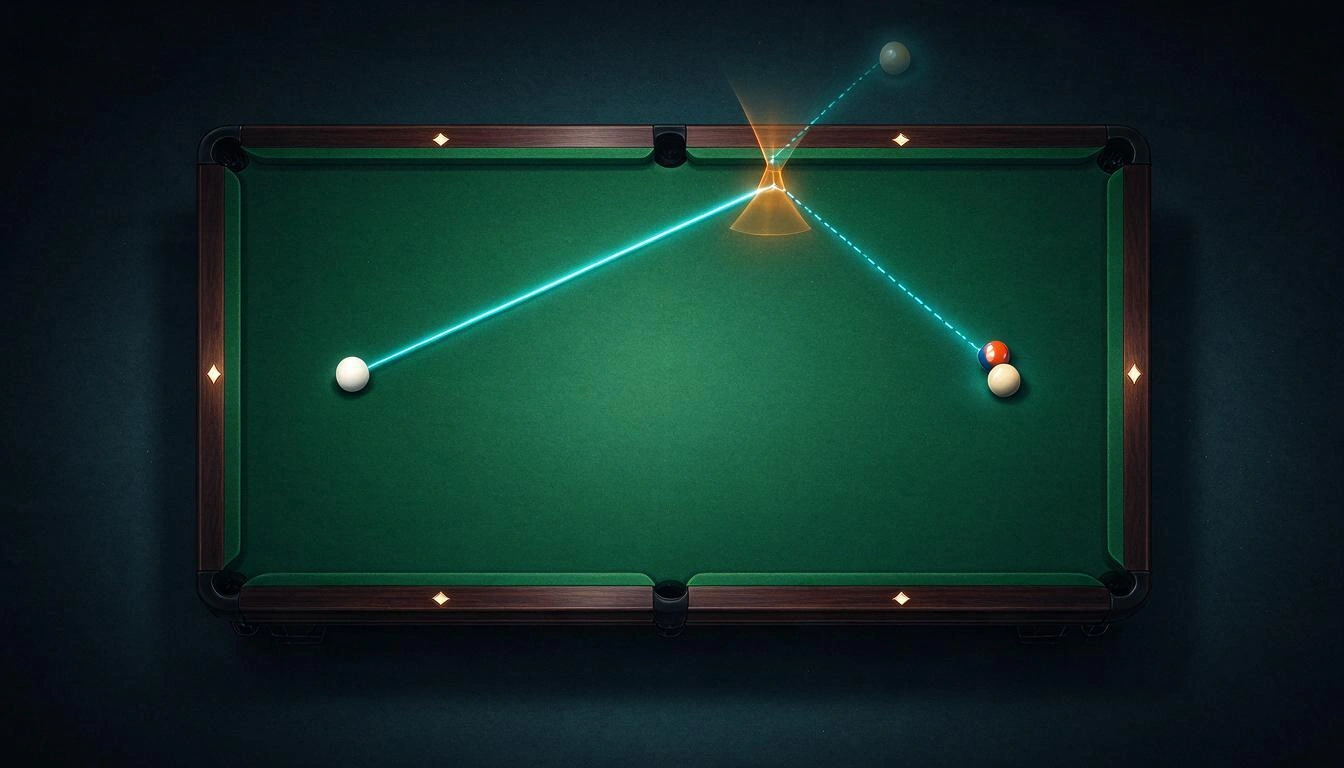
Three details that separate those who make kicks from those who pray for them:
- Aim at the intersection, not at the diamond. The useful point is where the diamond line intersects the edge of the rubber, not the diamond embedded in the wood (PoolDawg).
- One rail before two. Each added rail multiplies the error. The mirror system to one rail is the one that has a margin of truth; two-rail systems and displacement systems like plus two are another league.
- Know your margin. A kick is not "it goes in or it doesn't": it has an angular tolerance that narrows with power and shifts with side spin. If you don't know how much tolerance you have left, you can't decide between the kick and the defensive shot.
In a ranking season, the kick is not a flourish: it is the play that avoids the foul when your ball is blocked, and fouls on the expensive table are what finances the opponent.
What is the mistake that gives away the most games? Scratching the cue ball
Scratching the cue ball after the impact. It is the costliest mistake because not only do you lose your turn: you give away a free ball, and on a high-stakes table that usually means the entire game. And it is preventable, because the danger zone is deduced from the same geometry as before: the cue ball is going to exit at some point in the fan that goes from the tangent to the rolling line, so it is enough to check if any pocket falls within that fan — including the one that remains after one or two rebounds.
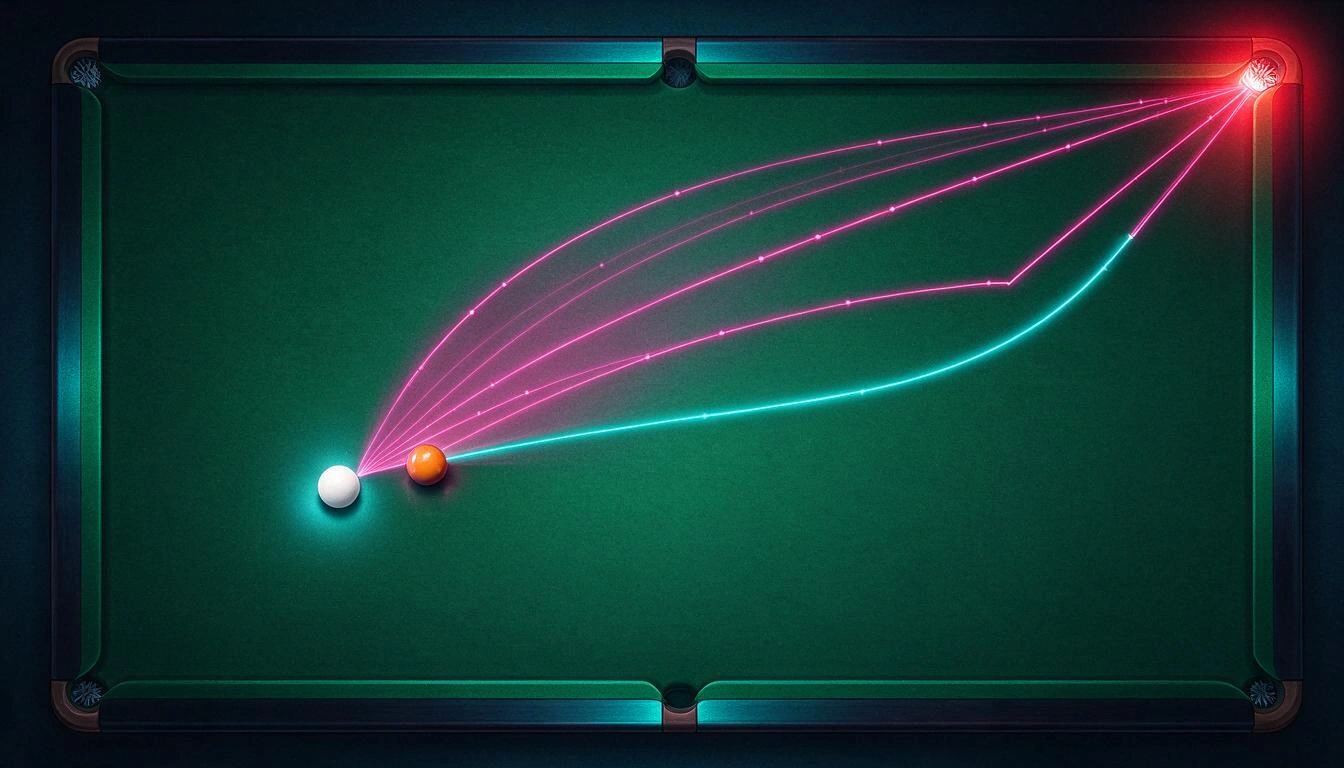
The protocol consists of three questions before shooting, in order:
- Where does the cue ball exit with each of the three strokes (follow-through, roll, reverse)?
- Does any of those three exits, or the fan between them, point directly to a pocket or after a rebound?
- If the answer is yes: can I change my stroke, or reduce the power so that the cue ball does not reach?
Almost always the solution is not to change the aim, but to reduce the power. It is the most neglected variable: a source from the sector estimates that a speed error of 10% on a shot where the cue ball travels almost two meters shifts the stopping point by about 18 centimeters, while an aim error of one degree at a meter and a half moves the target ball around two and a half centimeters into the pocket (Quarter King Billiards, speed control, 2026). In other words: you invest in exotic aims what you should invest in speed.
How is this trained measurably in two weeks?
With progressive practice: a specific exercise, a fixed number of attempts, the percentage recorded, and the difficulty that increases only when the percentage is sustained. It is the principle of progressive practice routines that Alciatore published as open material, and it works the same with a physical table as with an app: what changes is not the physics, but the discipline of writing down the result.
A two-week plan that fits with the seasonal calendar, in batches of 10 attempts:
| Days | What you train | Metric |
|---|---|---|
| 1–3 | Fractions: name the fraction before shooting and hit it | % of hits at 3/4, 1/2 and 1/4 of the ball |
| 4–6 | Stopping point: follow-through, roll and reverse from the same position | % of cue balls that stop in the marked zone |
| 7–9 | Kicks to a band by mirror | % of legal contacts with the blocked ball |
| 10–12 | Cue ball safe: the same shot with the minimum power that goes in | % of shots without the cue ball near the pocket |
| 13–14 | Break and first ball | Balls pocketed and center control |
The golden rule is that you do not move up a block with less than 70–80% in two consecutive batches. If you reach the kick block with the fractions at 50%, you are not training kicks: you are accumulating noise.
This is where a tool comes in, and it is worth mentioning what kind of tool. The angle and band calculator for 8 Ball Pool from AiToolsForApps is a geometry trainer that works outside of the game: you place the balls in an editor by dragging them (with a magnifying glass for your finger and up to four obstacles), and it returns the contact point, the ghost ball, the cut angle with one decimal, and the corresponding ball fraction, as well as the three exits of the cue ball — tangent, roll, and reverse — drawn on the table. For the bands, it reads the position in diamonds and publishes the margin it works with. And it warns when the cue ball's exit fan points to a pocket, following each ray up to two bands, with the corresponding advice (reverse, follow-through, or less power).
For the measurable part, it brings 18 exercises spread across 5 routes — mastery of the ball fraction, the Berlin master, stopping point control, no scratching the cue ball, and break and first ball — and generates a printable A4 PDF notebook with one page per exercise: the table drawn, the stroke, the power, the common error, two batches of ten boxes to mark and a final record sheet for six sessions. That is exactly the format of the table above, but on paper and with your numbers. You can generate the diagram and the notebook without registering (a rotating slot for each thing); saving positions, accumulating history, and requesting the explained reading by AI in three paragraphs requires an account.
And it is worth emphasizing what it is not, because the sector is full of the opposite: it does not overlap with the game, it does not read the mobile screen, it does not work during the game, and it does not aim for you. It does not give coins, tricks, generators, or modified APKs. It is an independent app, not affiliated with Miniclip SA. Tools that promise the opposite are scams, Miniclip punishes them with bans and often come with malware as a bonus.
Frequently Asked Questions
When does the Ocean Drive Heist season of 8 Ball Pool start and end?
It started on November 4, 2026, and the official site sets the main block until November 25, 2026, with missions from the 16th to the 25th, the Showdown from the 22nd to the 25th, and token redemption until December 2, 2026.
What is the latest version of 8 Ball Pool in November 2026?
The current branch is 56.3x. Uptodown dates version 56.35.0 on November 9, 2026, and the App Store shows that same version on the page consulted on November 14, 2026; version 56.34.0 is immediately prior, from the early days of November.
Is it worth upgrading to expensive tables during a seasonal event?
Only if your win rate can handle it. The entry fee rises much faster than the skill, and on an expensive table, a foul or a scratch equates to several games on the previous table. The wise choice is to step up one level, play 30 or 40 games, and decide based on the percentage.
What does it mean that half a ball is 30 degrees?
It means that when the cue ball overlaps exactly half of the object ball at contact, the resulting cut is about 30 degrees. It is the anchor of the fraction aiming system: three-quarters of a ball is around 14.5°, a quarter of a ball is 48.6°, and an eighth is 61°.
Are the 30-degree rule and the 90-degree rule the same?
No, and they are often confused because half a ball also gives 30°. The 90° rule states that on a straight shot, the cue ball leaves perpendicular to the direction of the target. The 30° rule states that with the cue ball rolling, it deviates about 30° from its initial line, between a quarter and three-quarters of a ball. One describes the straight shot, the other the roll.
Can you train the geometry of 8 Ball Pool without installing anything weird or risking your account?
Yes, as long as the tool works outside of the game. Anything that overlaps the game, reads the screen, or aims for you is cheating and grounds for a ban. A geometry trainer that only draws diagrams and generates exercises for practice does not touch the game at any time.
How many attempts are needed to know if an exercise is mastered?
The standard of progressive practice is to work in fixed batches and require a sustained high percentage before increasing difficulty. Two batches of ten attempts with 70–80% or more is a reasonable criterion and, above all, notable.
What you take away from here
Ocean Drive Heist will last until the end of November 2026, and then another season with a different name and the same mechanics will come. What does not expire are the four skills: knowing where the cue ball goes, naming the fraction before shooting, calculating the bank by reflection with its margin, and not giving away the cue ball. If you train that with a number next to it, the next season will find you ready instead of finding you impulsively moving up tables. For that part, there is the angle and bank calculator for 8 Ball Pool from AiToolsForApps: exact geometry, printable notebook, and your percentages in writing.
Try the angle and cushion calculator for 8 Ball Pool: place the balls, see where the cue ball goes, and download your A4 workbook — no registration needed to get started.
Try the angle and cushion calculator for 8 Ball Pool: place the balls, see where the cue ball goes, and download your A4 workbook — no registration needed to get started.Keep reading
View all articles →
Can you get banned in 8 Ball Pool for using aim lines? What has changed in 2026
Broken Geode in Geometry Dash 2.2091: which mods are not working and how to keep creating
DLS 27 in December 2026: what is confirmed, what is not, and what happens to your club, your squad and your kits when you update