Honor of Kings
Can you get banned in Honor of Kings for using third-party tools? What ACE detects in the 2026 wave
Team at AiToolsForAppsWritten with AI assistance18 min readIn summary
- On November 3, 2026, Honor of Kings released a new anti-cheat statement: it says it explores new detection methods, sanctions based on the nature and severity of the offense, and that its team monitors the game 24/7 acting daily (official Honor of Kings news).
- The 2026 wave of bans against skin scripts and GFX tools is supported by four vectors: file integrity, unauthorized processes, memory scanning, and behavior patterns (BitTopup News security guide).
- First documented offense: suspension of 7 to 14 days with a ban on ranked play, competitive events, and social features; recidivism: permanent closure, and appeals for the use of modification tools have a success rate of less than 1% (same source).
- The engine that watches is ACE (Anti-Cheat Expert), from Tencent, with kernel-level access and present in about twenty games (Anti-Cheat Expert on Wikipedia). Behind it is the account credit from the Tencent Game Safety Centre.
- The boundary is physical: if something touches the client, memory, or your credentials, it is a risk. If it happens outside the game —styling the nickname with Unicode on your own mobile, setting up an emblem, a thumbnail, or an overlay— there is nothing ACE can inspect.
With over 260 million monthly active users worldwide, announced by Level Infinite on October 29, 2025, during the tenth anniversary of the game (Pocket Gamer), Honor of Kings is one of the most monitored mobile ecosystems. And 2026 has been the year when that monitoring has become WhatsApp group chat: each wave of bans leaves half the clan wondering if this also bans. The short answer is that it depends on one thing —whether the tool touches the game or not— and this article draws that line with the sources in hand. At AiToolsForApps, we apply that same criterion to Honor of Kings, our AI toolkit for those who create, sell, or compete: everything it does happens outside the client, as you will see in the nick and team name styles for Honor of Kings.
What did Honor of Kings announce on November 3, 2026?
The anti-cheat statement from November 3, 2026 does not introduce a new rule: it tightens the enforcement of the one that already existed. It essentially says three things: that the studio continuously explores new methods to detect cheaters, that the sanction is calibrated according to the nature and severity of the case, and that there is monitoring around the clock with daily actions and periodic publication of results (official news list).
That pattern —monitor, sanction, publish— repeats throughout the year. In the same vein, the game has released specific statements such as the one regarding the match-fixing campaign detected in Peak Tournament matches, with daily review of reports and publication of files (match-fixing statement).
Two practical consequences for an average player:
- There is no "safe window". If detection is continuous, the fact that a script worked for three weeks does not mean it is not already flagged: the waves are retroactive over data already collected.
- Severity matters. The same family of offenses is not punished the same way the first time as the third, and that explains why two friends with "the same installed" end up with different sanctions.
What is ACE and why does it see more than people think?
ACE (Anti-Cheat Expert) is Tencent's own anti-cheat that protects Honor of Kings. It operates with kernel-level access, meaning it has the highest level of control over the user's system, and protects around twenty titles, including Delta Force, Call of Duty: Mobile, Wuthering Waves, or Arena Breakout: Infinite. The brand "Anti-Cheat Expert" was announced in 2021, but the technology dates back to 2005 as an anti-bot for Free Fantasy Online (Anti-Cheat Expert on Wikipedia).
That kernel detail is what many people do not internalize. An anti-cheat that operates at that level does not just look at "whether you cheat in the game": it can observe the environment in which the game runs. The sources documenting the 2026 wave describe a surface of inspection that includes root status, emulator environments, APK integrity, running processes, storage cache, package name and version, screenshots, sensor data, and modifications to system libraries (BitTopup News).
A kernel anti-cheat does not ask "Did you cheat?", it asks "Is the game running where and how I left it?".
ACE is also a member of the Fair Play Alliance and has presented its work at GDC and Gamescom, which gives a hint of the project's bias: it is not a reactive filter, it is a detection program with a roadmap.
What are the four detection vectors of the 2026 wave?
The four vectors that describe the sources of 2026 are file integrity, unauthorized processes, memory scanning, and behavior patterns. Each one targets a distinct family of manipulation, and together they cover almost everything a skin script or a GFX tool needs to do to function.

| Vector | What it checks | What it reveals |
|---|---|---|
| File integrity | Verification of client files on every startup | Replaced textures, edited configuration files, repackaged APK |
| Unauthorized processes | What is running alongside the game | Active GFX tools, injectors, overlays hooking into the process, emulator environments |
| Memory scanning | Accesses and memory states of the game process | Hot patching, reading/writing values, hooks |
| Behavior patterns | Analytics of how you play, not what you have installed | Impossible reactions, identical repeated routines, automation, systematic AFK |
Source of the four vectors and the inspected surface: GFX tools and skins scripts safety guide 2026.
The fourth vector is the one that breaks the forum's favorite argument: "it's just visual, it doesn't give an advantage". It may not give an advantage, but the first three vectors do not measure advantage; they measure alteration. A skin script that replaces textures in the data directory of the package com.levelinfinite.hok.gp fails the integrity check just like an aimbot, because the check is the same.
What penalty exactly applies and how long does it last?
According to the 2026 wave documentation, the first offense for modification tools results in a suspension of 7 to 14 days and restriction of ranked modes, competitive events, and social functions; reoffending ends in permanent account termination with no recovery options. During the suspension, daily rewards, ranked progress, guild activity, and season pass progress are lost.
| Situation | Documented consequence |
|---|---|
| First offense with modification tool | Suspension of 7–14 days + blocking of ranked, competitive, and social |
| Reoffending | Permanent closure, with no recovery route |
| During the suspension | Daily rewards, rank progress, guild, and season pass are lost |
| Appeal for using modification tools | Success rate below 1% |
| Modifying the client in official competition | Explicitly prohibited in esports regulations |
The first three rows and the appeal rate come from BitTopup News; the last one is from the official esports regulations of Honor of Kings, which prohibits "any modification of the Honor of Kings client" by players, teams, or third parties acting on their behalf, defines ringing (playing with someone else's account or inducing someone to do so) as an infraction, and reserves the harshest punishment for match-fixing.
And it's not just administrative: in China, there have been prison sentences for developers of Honor of Kings cheats (South China Morning Post). Whoever sells the script assumes legal risk; whoever installs it assumes account risk.
What is the credit score of the Tencent Game Safety Centre and how does it affect you?
The game credit of Tencent is a reputation score per account that moves within a range of 0 to 1,200 points, recalculated monthly and built on five dimensions: account information, daily activity, game assets, contribution to security, and penalties for cheating. Below 100 points, the account loses access to chat and social functions.
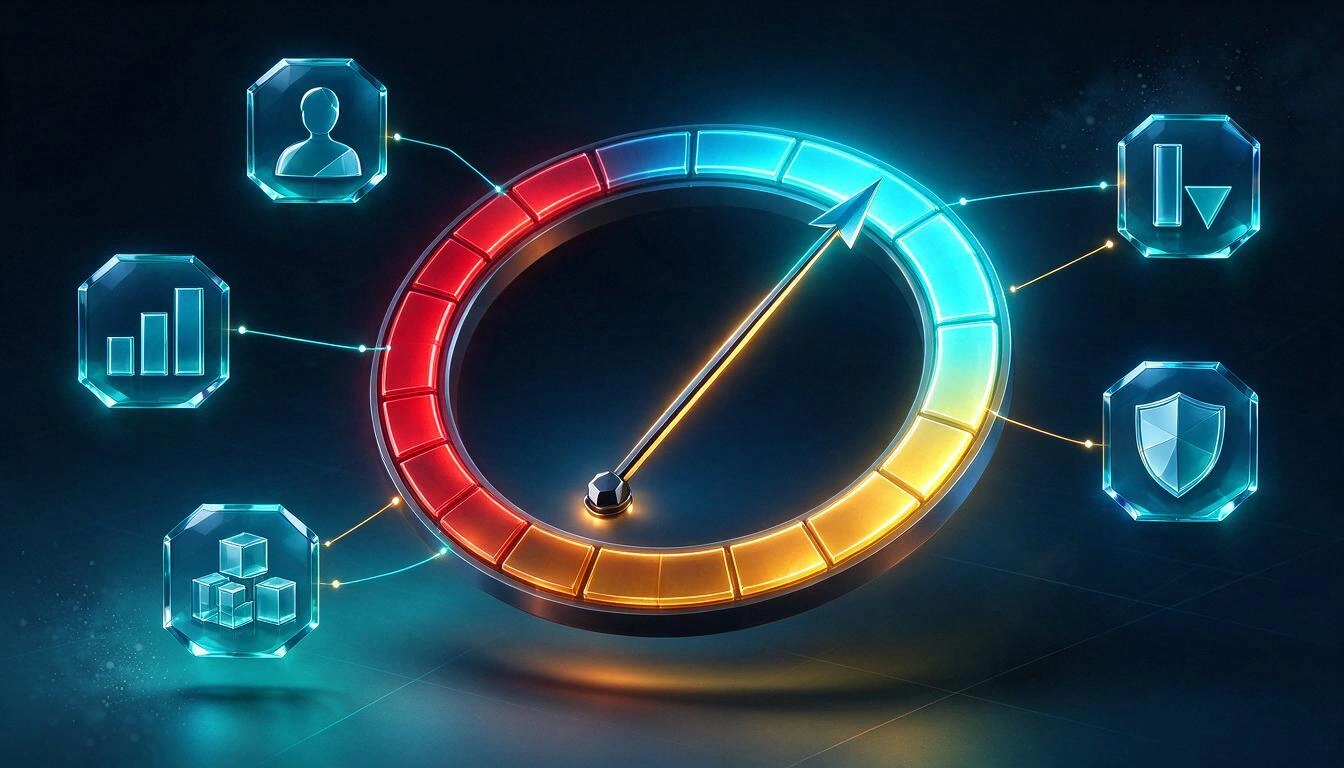
| Dimension | Rises when… | Falls when… |
|---|---|---|
| Account information | Data is authentic and verified | There are inconsistencies or impersonation |
| Daily activity | You play regularly | You leave matches, systematic AFK |
| Game assets | You accumulate legitimate progress and items | — |
| Contribution to security | You report cheats and the report is confirmed | You report falsely on a massive scale |
| Penalty for cheating | — | You use unauthorized third-party programs |
Tencent introduced this rating system for Honor of Kings to curb cheating and reward "civilized" play (SCMP, 2017) and later extended it as a credit system for players (Pandaily).
The important thing about credit is that it turns account security into something cumulative. It's not "I get caught or I don't": each episode leaves a mark on a figure that conditions what you can do months later. A player with low credit is also a player with less margin when the next automatic review arrives.
Where is the line between what gets banned and what doesn't?
The line is not "visual versus functional," nor "free versus paid." It's much simpler: Does the tool touch the game client, its memory, its process, or your credentials? If the answer is yes, it falls within the radius of the four vectors. If everything happens outside the game and the result is text that you write or an image that you publish, there is nothing to inspect.
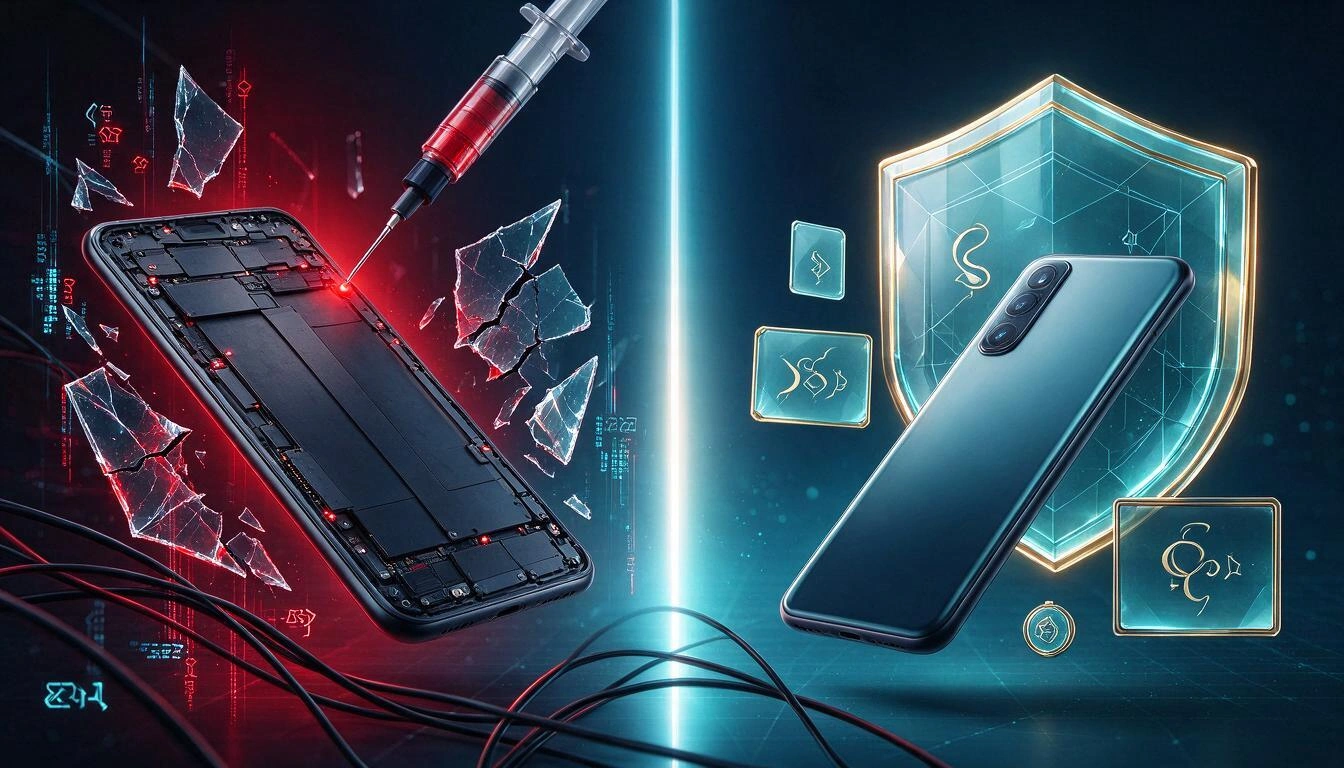
| Practice | Does it touch the game? | Ban risk |
|---|---|---|
| Skin script that replaces textures in the package directory | Yes, files | High — integrity fails on every startup |
| GFX tool that edits configuration files or forces FPS | Yes, files and process | High — unauthorized files + process |
| Injector, patcher, or mod menu | Yes, memory and process | High — and is often a detected recurrence |
| Macros, bots, or game automation | Yes, behavior | High — behavior pattern |
| Lending or selling the account, boosting with credentials | Yes, account | High — prohibited in the terms of service |
| Giving your player ID to a website that promises to "verify" | Yes, account | High — theft and sanction vector |
| Playing on unsupported emulator or with root | Yes, environment | Medium-high — detectable as environment |
| Styling your nickname, team name, or tag with Unicode on your own mobile | No | None from the tool — the text is typed manually in the game |
| Designing emblem, avatar, or team header outside the client | No | None |
| Creating a YouTube/TikTok thumbnail or live overlay | No | None — lives in the editor or in OBS, not in the game |
| Using the official graphic settings of the game | No | None |
References: the vectors and the detail of files and package, from BitTopup News; the prohibition against lending or sharing the account, from the terms of service of Honor of Kings.
An honest nuance about Unicode: styling the nickname is not an anti-cheat risk, but it does have content rules. The name is still subject to the game's rules —nothing offensive, nothing that imitates a hero or official personnel— and the game keyboard may reject specific glyphs or count them differently than you expect. That is not a sanction: it is a text field that does not accept what you have pasted.
Why are websites asking for your ID "to verify" the worst risk of all?
Because they mix both dangers at once: they expose you to a sanction for account manipulation and, additionally, to a theft that the anti-cheat will not undo. The game's terms are explicit that you cannot sell, resell, rent, lend, or give access to your account to anyone, and the competitive regulations define playing with someone else's account as an infraction.
Signs that a website is asking too much from you:
- It asks for your player ID or username "to check that you exist" before giving you a cosmetic result.
- It asks you to log in with your Level Infinite, Google, Apple, Facebook, or WeChat account for something that does not need your account.
- It promises you skins, diamonds, or free rewards in exchange for verification.
- It asks you to install an alternative APK, a "patch," or a tool that runs alongside the game.
- It asks for a screenshot with the ID visible without offering to blur it.
The healthy rule: a cosmetic tool does not need to know who you are in the game. If the result is text that you are going to paste manually or an image that you are going to upload to YouTube, there is no technical reason for it to ask for credentials or ID. If it asks for them, what you are buying is not the pretty nickname.
How to customize a player's or team's identity without touching the client?
Doing everything outside the game and entering the client only to manually write the result. This is the flow that creators and team captains use today: the nickname is composed as Unicode text on mobile, the emblem and covers are designed in an editor, and only what fits in its own text field reaches the game. This is exactly the criterion with which Honor of Kings is built, the AI toolkit from AiToolsForApps for this game.
What this tool does, and does not touch anything in the client:
- Nickname styles, team name, and tag with Unicode: 15 typographic styles and 7 categories of decorators (38 glyphs in total), with a symbol searcher by name. All styling is calculated in your own browser, without an account and without limits.
- Invisible characters: two variants of filler (Hangul filler) and three presets, for names with separation or seemingly empty.
- Length validator that measures the three things that matter at once: grapheme clusters, bytes, and slots, with a traffic light. And here is the honesty of the approach: the styles and limits are shown marked as "unchecked in the game" and as "unverified reference limits", because the only real judge of what enters the name field is the client itself. The tool does not promise you that a glyph will pass: it tells you it does not know.
- 80 example names in 8 categories and an idea generator that returns only ASCII, designed for what is usually accepted without issue.
- Team emblem pack: 7 mascots, 4 palettes, 5 frames, with delivery of square avatar 1024×1024 and header 1920×1080; recomposing frame, palette, name, or tag is free and without AI.
- Thumbnails and overlays: thumbnails in 16:9 (1280×720) and 9:16 (1080×1920) with printable badges and reserved areas respected (timestamp and progress bar in YouTube; description, action column, and search bar in TikTok), and live overlays 1080×1920 and 1280×720 that never cross minimap, skills, or scoreboard. The overlay is composed with verified real transparency and zero AI.
- Recruitment announcement in a long version for Discord or Reddit and a short version in plain text, with a deterministic backup template if the AI fails.
And what it does not do, which is the relevant part for this article: it does not ask for your player ID, nor your account, nor your credentials at any point. Moreover: when you upload a screenshot for a thumbnail, it offers you to blur the area where your ID appears. There is also a filter of 49 prohibited terms with leetspeak normalization applied both in the browser and on the server, and 51 extra brand and game terms banned in the prompts, so that neither you nor the AI can slip in a name that brings you content issues.
If you want to try it, the natural place is the page for nickname and team name styles for Honor of Kings: it is used without registration and what you generate can be claimed later.
Frequently Asked Questions
Can you get banned in Honor of Kings for using third-party tools?
It depends on what the tool does. If it modifies client files, injects into the process, reads or writes memory, automates games, or handles your credentials, yes: it falls squarely into the four detection vectors, and the first documented infraction in 2026 results in 7 to 14 days of suspension, with permanent closure in case of recidivism (BitTopup News). If the tool is purely external —a Unicode text generator or an image editor— there is nothing installed or altered that ACE can detect.
Are you banned for using skin scripts if "they're only visual"?
Yes. The file integrity check does not measure competitive advantage; it checks if the client files are the originals. A skin script replaces textures in the package data directory, so it fails the check just like a functional cheat. In the 2026 wave, that is precisely the most sanctioned profile.
Are GFX tools safe in Honor of Kings in 2026?
No. GFX tools edit configuration files and run as an unauthorized process alongside the game, so they are detectable by two vectors at once. The risk-free alternative is to use the game's official graphic settings, which is what the security guides themselves recommend.
Can I get banned for using weird symbols or Unicode in my nickname?
Not for using Unicode: writing a name with special characters is using the game's name field, not modifying the game. What does apply are the content rules for names (nothing offensive, nothing that imitates heroes or official personnel) and the limits of the field itself, which may reject a glyph or count it differently than you expected. That's why it's wise to be wary of any tool that promises a specific glyph "works safely".
What is the credit score and how do I recover it?
It is the account reputation score from the Tencent Game Safety Centre: 0 to 1,200 points, recalculated monthly across five dimensions. It increases with authentic account data, regular gameplay, accumulated assets, and confirmed cheating reports; it decreases with AFK, leaving games, and using unauthorized programs. Below 100, social and chat functions are lost (SCMP).
Is it worth appealing a ban for third-party tools?
Almost never. For sanctions due to the use of modification tools, the documented success rate of appeals in 2026 is below 1%, and the policy for this type of ban is non-recovery. It is worth appealing if you believe it is a false positive —for example, an environment detection on a device you have not modified— but not as a strategy to reverse actual usage.
Is it safe to give my player ID to a website that gives me skins or "verifies" my account?
No. No legitimate cosmetic tool needs your ID or credentials to generate a nickname, emblem, or thumbnail for you. Sharing account access is prohibited by the terms of service and also exposes you to theft that game support will not reverse.
Can I use a live overlay without getting banned?
Yes, if the overlay lives in your streaming software (OBS, Streamlabs) and is an image layer that composes over the video, not over the game process. What is risky is an overlay that hooks into the game to draw within it: that is an unauthorized process interacting with the client.
Does playing on an emulator or with a rooted mobile count as cheating?
ACE inspects the root status and emulator environments as part of its checking surface. Not every emulator implies automatic sanction, but a rooted device or unsupported environment reduces your margin and may block your access or flag you in reviews. If you compete, the conservative option is a stock device.
Conclusion: the right question is not "will I get banned?", it's "does this touch the game?"
In 2026, Honor of Kings has made it clear with actions what it already stated in its terms: detection is continuous, supported by four vectors that measure alteration more than advantage, and account reputation is cumulative. This makes the decision easy to make without being an engineer: everything that is installed, injected, patched, or asks for your credentials is a risk; everything that is composed outside and enters the game as text that you write or image that you publish is not.
That is the line on which Honor of Kings is built, the set of AI tools from AiToolsForApps: nickname calculation on your own device, emblems, thumbnails, and overlays mounted outside the client, zero requests for ID or account, and honest labels of "unverified" where the game is the only one in charge. You can see it working in the nickname styles and team name for Honor of Kings, without registering.
Style your nickname, team name, and tag without touching the game client: try AiToolsForApps's Honor of Kings tools for free and without registration, and later claim what you've created.
Style your nickname, team name, and tag without touching the game client: try AiToolsForApps's Honor of Kings tools for free and without registration, and later claim what you've created.Keep reading
View all articles →
Team Names and Tags in Honor of Kings: What the Selections of the Esports Nations Cup 2026 Do and How to Copy It for Your Squad
Broken Geode in Geometry Dash 2.2091: which mods are not working and how to keep creating
DLS 27 in December 2026: what is confirmed, what is not, and what happens to your club, your squad and your kits when you update