Minecraft
The 12 Calcite Blocks of Winter Drop 26.4: The New White Palette for Building
Team at AiToolsForAppsWritten with AI assistance13 min readIn summary
- The Snapshot 7 of Java Edition 26.4, released on November 3, 2026, adds 12 calcite building blocks divided into three families: Calcite (pillar, slab, stair, wall), Polished Calcite (slab, stair, wall), and Polished Calcite Bricks (slab, stair, wall), according to the Snapshot 7 page on the Minecraft Wiki.
- Mojang presented this snapshot as the last feature pack of the winter drop: the next should be pre-releases, as reported by SyntaxMine on November 3, 2026.
- The Snapshot 8 arrived on November 10, 2026 and did not touch the palette: it fixed the dragon fight and added two languages, according to the Snapshot 8 page. As of November 12, 2026, there is still no pre-release or official date; 26.4 is only announced for Q4 2026.
- Calcite is no longer a niche material: besides the intermediate ring of amethyst geodes, 26.4 generates it in patches within the new ice caves biome, beneath cold biomes.
- The three finishes convert 1 calcite into 1 block (2×2 recipes) and the stonecutter prevents the loss of stairs: it is there where the calculation in stacks and shulkers decides whether your dome is built in an afternoon or in three.
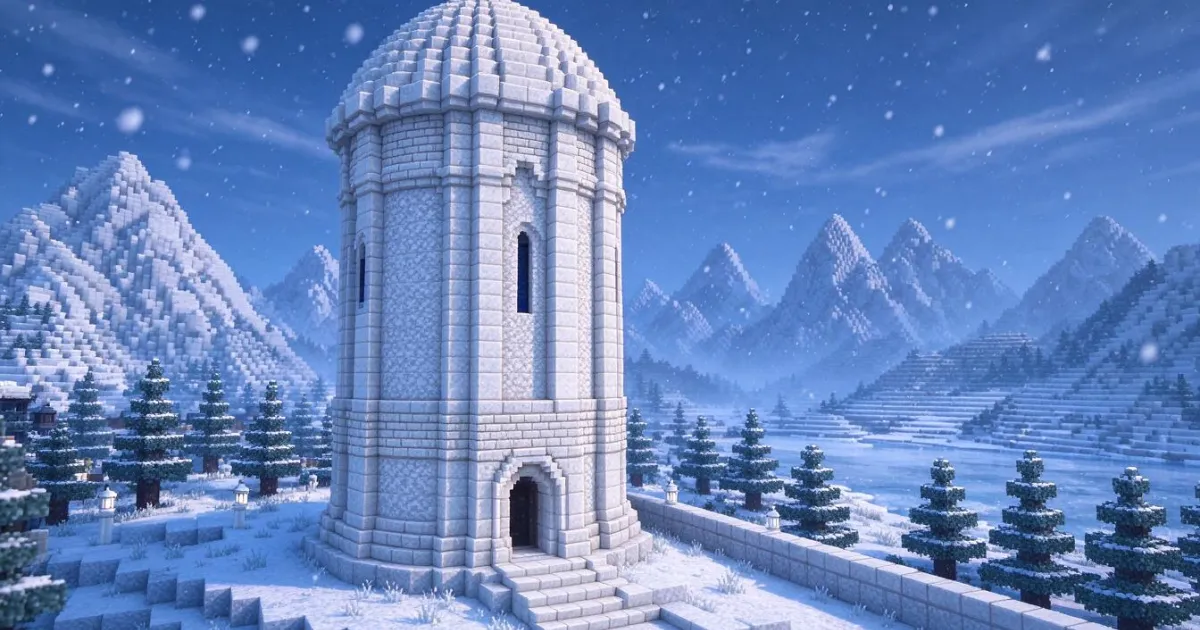
For five years, calcite was that white block you mined unintentionally while opening a geode to get amethysts. With the Winter Drop 26.4, it becomes a complete palette of twelve pieces, and that changes very specific conversations: what you fill a dome of 15 in diameter with, how to finish a white tower without it looking like quartz, and how many stacks you need to carry in your backpack. In this article, we review the three families, where the material comes from, how each piece is crafted, and how it coexists with quartz, diorite, andesite, and white concrete. And since the last step of any large construction is logistics, we also calculate the materials for a tower with a dome: that calculation is exactly what aiMineCraft automates, the AI tool suite for Minecraft creators from AiToolsForApps, with its figure generator and material calculator for Minecraft.
What 12 blocks of calcite does Snapshot 7 of Minecraft 26.4 add?
Snapshot 7 of Java Edition 26.4, released on November 3, 2026, adds three families of calcite with 12 blocks in total: Calcite with pillar, slab, stair, and wall; Polished Calcite with its base block, slab, stair, and wall; and Polished Calcite Bricks with block, slab, stair, and wall. The Snapshot 7 page on the Minecraft Wiki also confirms that all variants can be cut in the stonecutter.
The structure is the same as always in Minecraft —base, polished, brick— but with a detail that builders have been asking for: the rough family also receives pillar, which is the piece that allows you to mark a vertical without breaking the tone.
| Family | Base block | Pieces it brings | What it’s used for in a build |
|---|---|---|---|
| Calcite | Calcite (already existed) | Pillar, slab, stair, wall | Speckled texture: rustic walls, natural rock, caves |
| Polished Calcite | Polished Calcite (new) | Slab, stair, wall | Smooth surface: large facades, domes, floors |
| Polished Calcite Bricks | Polished Calcite Bricks (new) | Slab, stair, wall | Regular pattern: cornices, detailing, murals |
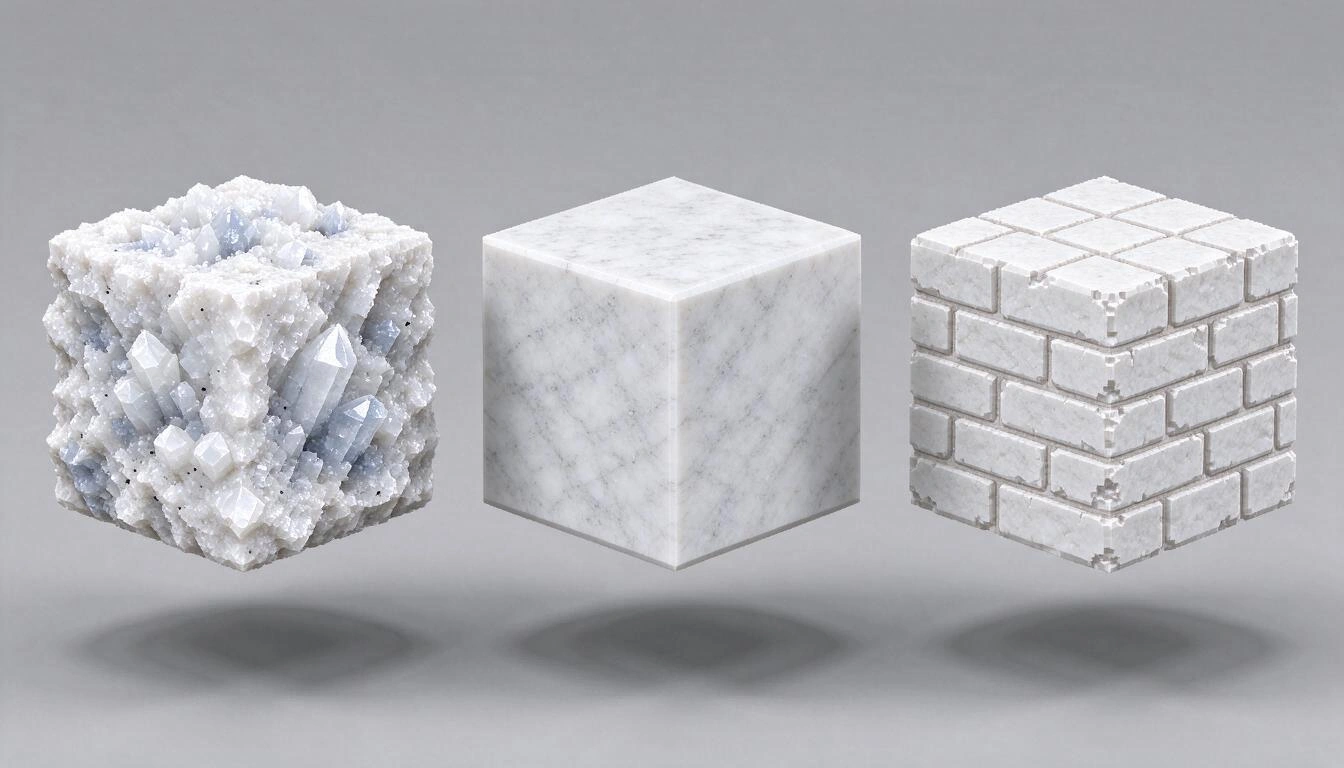
How is each calcite block crafted and how much calcite is needed?
The two key recipes are 2×2 and maintain the 1:1 ratio: 4 calcite in a square yield 4 Polished Calcite, and 4 Polished Calcite in a square yield 4 Polished Calcite Bricks, according to the breakdown of Snapshot 7 from SyntaxMine. That is to say: one block of raw calcite equals one block of any of the three finishes, with no loss. What does lose material are the stairs made at the crafting table.
The proportions per piece, collected in the recipe summary of Snapshot 7 from EndgameTools, are the usual ones in the game:
| Piece | Crafting table recipe | Calcite per unit | With stonecutter |
|---|---|---|---|
| Polished Calcite / Bricks | 4 in a square → 4 | 1 | 1 → 1 |
| Calcite Pillar | 2 stacked → 2 | 1 | 1 → 1 |
| Slab | 3 in a row → 6 | 0.5 | 1 → 2 |
| Stair | 6 → 4 | 1.5 | 1 → 1 |
| Wall | 6 → 6 | 1 | 1 → 1 |
Practical rule: if your design requires a lot of stairs —and any stepped dome or cornice requires them—, the stonecutter saves you 33% of the material compared to the crafting table (from 1.5 to 1 calcite per stair). In a build of 500 stairs, that’s 250 blocks, almost 4 stacks.
The stonecutter changes the production chain
With the stonecutter, you don’t need to go through the intermediate polishings to get to the finish you want: raw calcite goes in and the piece comes out. With the crafting table, you do: calcite → polished → bricks → piece. If you’re in a survival game and you’ve brought 20 stacks of calcite from an expedition, the stonecutter is the first block you place in the camp.
Where is calcite found in 26.4?
The classic source remains the intermediate ring of amethyst geodes: the amethyst geode page describes the three layers (smooth basalt outside, calcite in the middle, amethyst inside), with a default calcite layer thickness of 3.2, generating between Y=-58 and Y=30 and a 1/24 per chunk chance of attempting to generate a geode. But 26.4 adds a second, much more convenient source.
The new ice cave biome, which generates under cold biomes (snowy plains, snowy taiga, icy peaks, frozen oceans), has compact ice walls with calcite patches, according to the ice cave biome page. For a builder, this means that calcite goes from being a "byproduct of going for amethysts" to a resource that is mined in volume in a specific biome.
Two important facts when mining:
- Calcite requires a wooden pickaxe or better; without the proper tool, it drops nothing, and its hardness is 0.75 —it breaks very quickly—, according to the calcite page.
- In ice caves, patches of stone and deep slate also generate, allowing diorite and andesite to appear in the same biome: you have all three grays of the palette at your fingertips.
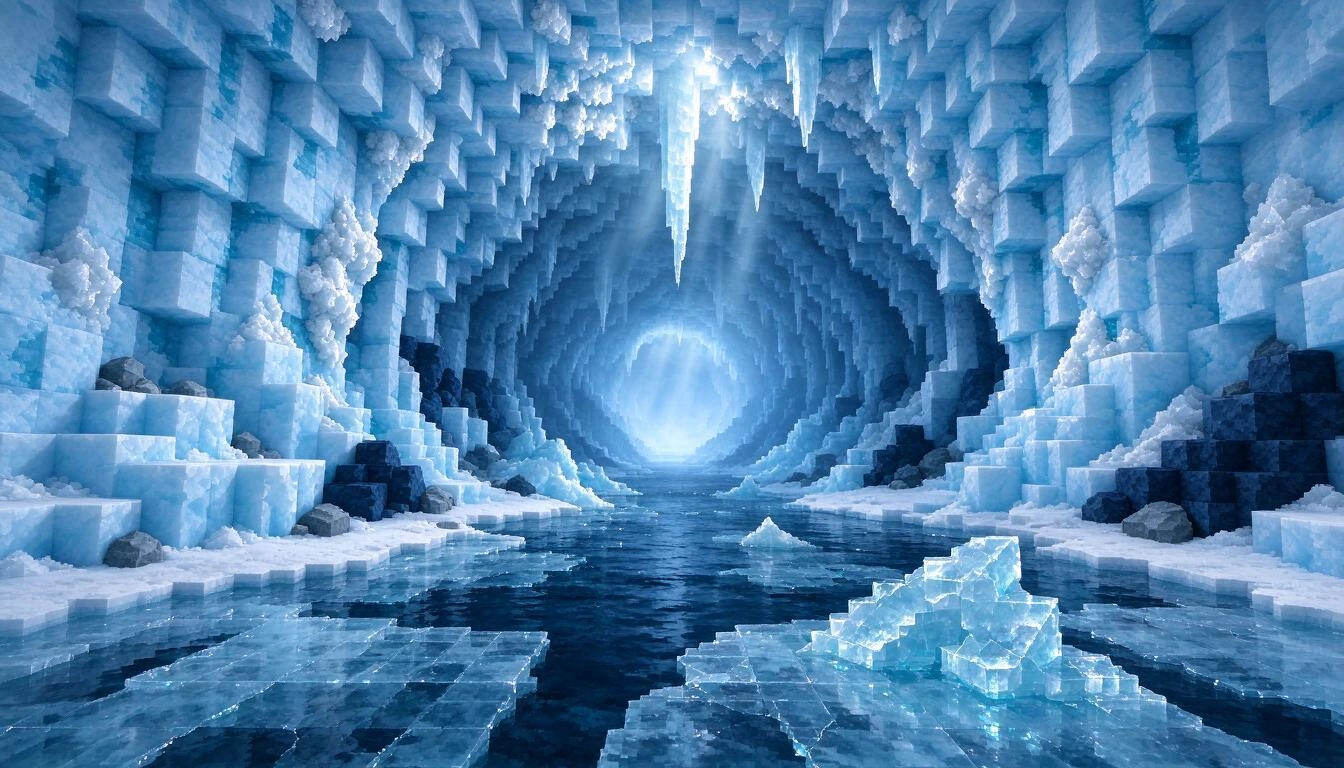
Does calcite compete with quartz, diorite, or white concrete?
It does not compete: it occupies a niche that was missing. Calcite is the only spotted and cool white that now has a complete set, and its color on the map is 36 TERRACOTTA_WHITE, different from the 14 QUARTZ shared by the quartz block and diorite and the 8 SNOW of white concrete. For map art and large facades, that is a real fourth shade, not a duplicate.
| Material | Map Color | How to Obtain | Texture | Where It Wins |
|---|---|---|---|---|
| Calcite | 36 TERRACOTTA_WHITE | Mined (geodes, ice caves) | Cool spotted | Natural white, "living" stone, snow |
| Quartz Block | 14 QUARTZ | 4 nether quartz per block | Creamy smooth | Luxury, interiors, warm white |
| Diorite | 14 QUARTZ | Cobblestone + nether quartz → 2 | Warm spotted | Light gray, blends with stone |
| Andesite | Gray stone | Mined or cobblestone + gravel → 2 | Gray spotted | Medium gray, structure |
| White Concrete | 8 SNOW | Powder (sand, gravel, dye) wet | Flat, no grain | Pure modern white, no visual noise |
Sources for colors and recipes: quartz block, diorite and concrete on the Minecraft Wiki.
Three combinations that work
- Cool dome: Polished Calcite bricks on the facade, Polished Calcite stairs on the steps of the profile, and calcite walls on the cornice. All within the same family, the volume is read by the pattern and not by the color.
- Tower with hierarchy: Polished Calcite shaft, calcite pillars at the corners, and smooth quartz cap. The quartz, being warmer, works as "golden" without using gold.
- Mural and contrast: white concrete as a flat background, calcite and Polished Calcite Bricks for the drawing, and andesite for the shadow. The concrete has no grain, so the spotting of the calcite reads as intentional texture.
Where calcite does compete is with smooth quartz in large domes: until now, the canonical white dome was made with quartz, which requires trips to the Nether. Calcite is mined in the Overworld and does not require setting up a quartz farm.
How many stacks and shulkers does a calcite dome tower need
For a cylindrical tower of 15 blocks in diameter and 24 high, topped with a hollow dome of 15 in diameter, with four corner pillars, a cornice of walls, and the profile of the dome in stairs, about 1,420 blocks of raw calcite are needed: 22 stacks and a bit, which fit comfortably in a single shulker box (27 slots × 64 = 1,728). This calculation is original and comes from counting the geometry layer by layer, not from any external source.
The breakdown, with the conversions from the previous recipe table:
| Element | Piece | Units | Raw calcite (cobblestone) | Stacks |
|---|---|---|---|---|
| Tower shaft (24 rings of 40) | Polished Calcite | 960 | 960 | 15 |
| Hollow dome d=15 | Polished Calcite Bricks | 285 | 285 | 4 + 29 |
| 4 pillars of 24 | Calcite Pillar | 96 | 96 | 1 + 32 |
| Perimeter cornice | Calcite Wall | 40 | 40 | 40 units |
| Dome profile | Polished Calcite Stair | 40 | 40 | 40 units |
| Total | 1,421 | 1,421 | 22 stacks + 13 |
Two useful readings from that table:
- Without cobblestone, the 40 stairs cost 60 calcite (6 → 4): the total rises to 1,441. With 500 stairs, the difference is already several stacks.
- The tower ring is 40 blocks per layer, not 47 as π×15 would suggest. Circumferences on a block grid are not calculated with the circle formula; they are counted. And the dome does not have regular layers: in our calculation there are 40, 40, 40, 36, 32, 28, 48, and 21 blocks from bottom to top, because the horizontal spans change with height and the closing layer has a cap.
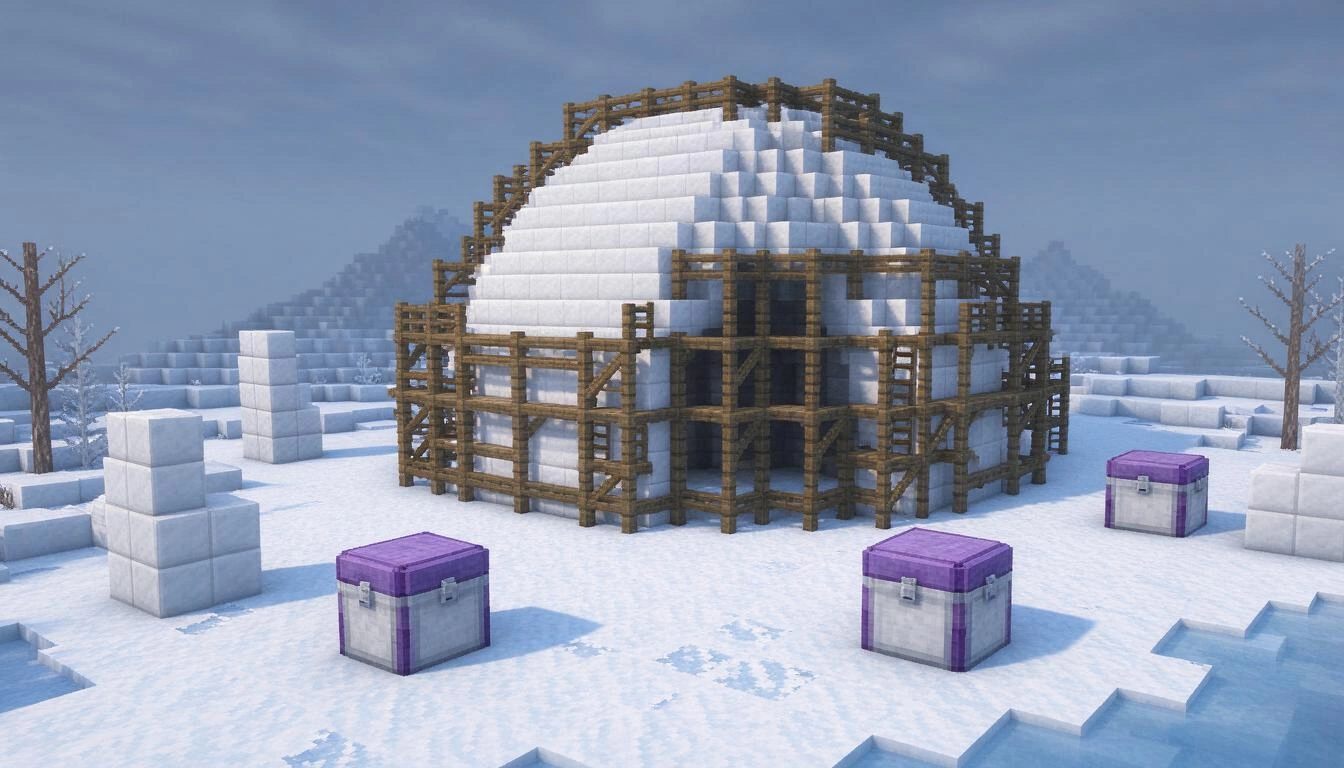
Why this is calculated with a tool and not by hand
Counting by hand the layers of a sphere, a dome, a cone, or a torus is just the work that no one wants to do twice, and it causes the most logistical errors: you show up on site with 14 stacks when you needed 22. The Geometry Study from aiMineCraft generates the eight shapes —circle, ellipse, sphere, dome, tower/cylinder, cone, torus, and arch— shows them to you layer by layer with the previous layer in ghost mode, gives you the reading by segments of each row (which is how it’s really built, "seven in a row, hollow, five in a row") and converts the total into stacks of 64, chests of 27 slots, double chests of 54, and shulkers of 27. You can check off segments as you place them, with vibration and automatic layer advancement, and print a sheet by sections of 40×40 blocks to build with your mobile next to the keyboard. All that study is free and without registration: the materials calculator and dome and sphere generator is used directly in the browser.
When is Winter Drop 26.4 coming out?
There is no date. Mojang has announced 26.4 for Q4 2026 and, as of November 12, 2026, has not published either a release date or the final name of the drop, according to the Java Edition 26.4 page. The only firm thing is the state of the development cycle.
The sequence up to today:
| Date | Version | What it brought for builders |
|---|---|---|
| Nov 3, 2026 | 26.4 Snapshot 7 | The 12 calcite blocks; last feature pack of the drop |
| Nov 10, 2026 | 26.4 Snapshot 8 | No new blocks: End dragon, two languages, adjustments |
| Pending | Pre-releases | Mojang indicated that the next builds should be pre-releases |
| Q4 2026 | 26.4 | No official date announced |
Sources: Snapshot 7, Snapshot 7 coverage and Snapshot 8.
For a builder, the practical message is: the palette is already closed. If Snapshot 7 was the last feature pack and 8 didn’t touch blocks, the 12 calcite blocks you test today in a snapshot are the ones you will have in the stable version. Designing now is not a gamble.
Frequently Asked Questions
How many new calcite blocks are there in Minecraft 26.4?
Twelve, divided into three families: Calcite (pillar, slab, stair, wall), Polished Calcite (block, slab, stair, wall), and Polished Calcite Bricks (block, slab, stair, wall). They arrived with Snapshot 7 on November 3, 2026.
How do you make polished calcite?
By placing 4 calcite blocks in a 2×2 square on the crafting table, which yields 4 Polished Calcite. Polished Calcite Bricks are made the same way, but with 4 Polished Calcite in 2×2. It can also be cut in the stonecutter.
Where can I quickly find calcite?
In the middle ring of amethyst geodes (between Y=-58 and Y=30) and, since 26.4, in the calcite patches on the walls of the new ice caves biome, which generates under cold biomes. A wooden pickaxe is sufficient.
Is calcite better than quartz for a white dome?
It depends on the hue and logistics. Quartz is a warm, smooth white and requires going to the Nether; calcite is a cool, speckled white that is mined in the Overworld and already has its own stairs, slabs, and walls. For snow-capped or mountain domes, calcite; for luxurious interiors, quartz.
How many stacks do I need for a dome 15 blocks in diameter?
A hollow dome with a diameter of 15 blocks is about 285 blocks, which is 4 stacks and 29 units. If you place it on a tower 24 blocks high of the same diameter, the total is around 1,421 blocks: 22 stacks and a bit, just one shulker.
When is the Winter Drop 26.4 officially released?
Mojang has only confirmed Q4 2026. As of November 12, 2026, no date has been announced and no pre-release has been published yet, although Snapshot 7 has already finalized the drop features.
Do calcite blocks work in Bedrock?
This article is based on the notes of Java Edition 26.4 Snapshot 7 and 8. We have not found a source that details the equivalent schedule in Bedrock, so we do not claim anything about that edition.
Design the white palette before mining the first geode
Calcite is already a full-fledged palette, the generation of 26.4 makes it accessible to any base in a cold biome and the drop features are finalized: it's a good time to design that dome you've been thinking about. What separates a design from a finished construction is almost never the idea, it's knowing how many blocks there are, in what order they go, and if they fit in a shulker. aiMineCraft, from AiToolsForApps, solves that part: the dome, sphere, and circle generator with material calculation gives you the layers, runs, and stacks without registering, and in the same app, you have studies on skins, banners, servers, and commands when the project grows.
Calculate your calcite dome in stacks and shulkers, free and without registration, at aiMineCraft
Calculate your calcite dome in stacks and shulkers, free and without registration, at aiMineCraftKeep reading
View all articles →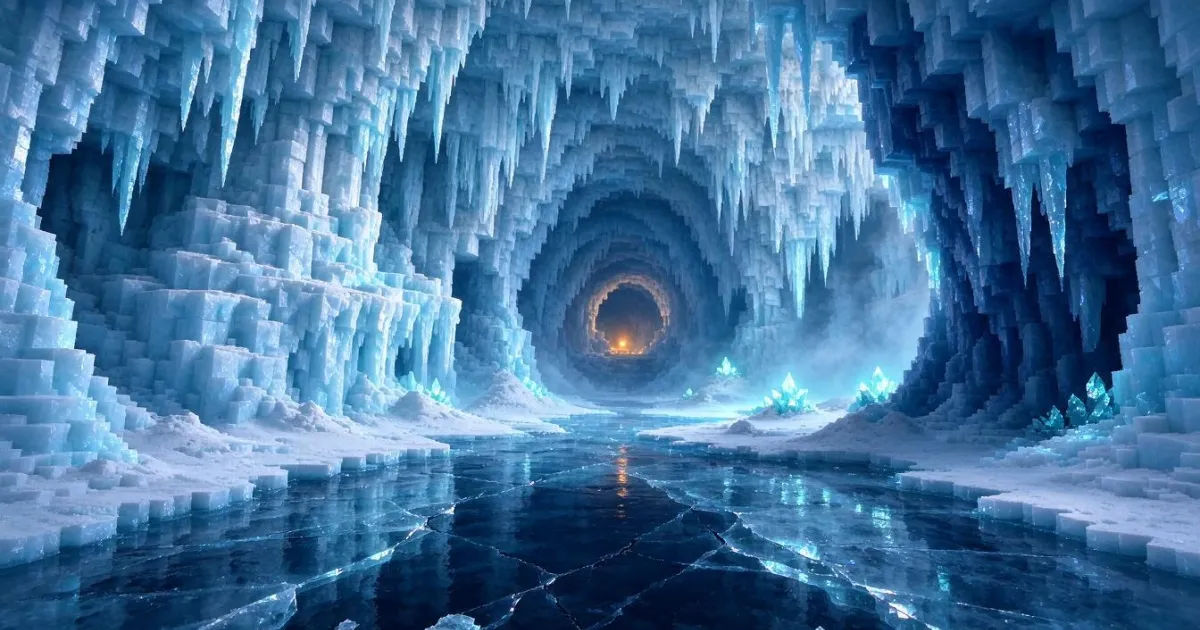
How to Prepare Your Minecraft Server for Winter Drop 26.4: Update, New Mobs, and Seasonal Event

Broken Geode in Geometry Dash 2.2091: which mods are not working and how to keep creating

DLS 27 in December 2026: what is confirmed, what is not, and what happens to your club, your squad and your kits when you update