Subway Surfers
63% of your runner's revenue comes on day 1: how to design the first 90 seconds and the first unlockable
Team at AiToolsForAppsWritten with AI assistance19 min readIn summary
- A hypercasual game generates 63% of its Day 60 ad revenue on Day 1, according to The State of App Monetization – 2026 Edition by AppsFlyer (data from January 2025 to March 2026, published in June 2026). Everything you design for Day 7 is too late.
- 79% of hypercasual monetizes solely with advertising (same report), but IAP from hybrid-casual grew 20% to $4.2 billion in 2025 (Sensor Tower, collected in the 2026 hyper-casual statistics from Genzopia): the future of runners is mixed.
- The first unlockable should cost 1-2 runs, not 40. With 130 coins per run, that’s ~260 coins; a price curve of x1.75 anchored at 5,000 coins puts it at 39 runs (45 minutes) and kills Day 1.
- A linear speed ramp has no ceiling: with a start of 9 u/s and +0.25 u/s², it crosses the human reaction floor (~250 ms, simple reaction time measured at 231-238 ms) at second 108. A logarithmic ramp saturated at 30 u/s never drops below 300 ms.
- SYBO maintains 28-day seasons in Subway Surfers City (Season 10, "Season of Jenny", from November 4 to December 2, 2026, according to the Subway Surfers City wiki). That schedule only works if the player makes it alive to Day 2.
If you’re putting numbers to an endless runner —coins per run, price of the first hat, how many u/s the runner earns each second— the data that should change your order of work is this: the money from your runner is not collected over two months, it is collected almost entirely on the first day. And that turns two seemingly minor decisions, the price of the first unlockable and the shape of the speed ramp in the first minute, into the two that decide whether the game exists. This article provides the figures for 2026, the arithmetic, and how to audit it before writing code; to make those calculations with a form instead of a spreadsheet, you have Subway Surfers, the AiToolsForApps app with AI tools for economy, difficulty, and patterns of a runner.
How much of a runner's revenue is played on Day 1?
63%. AppsFlyer measures that a hypercasual title generates 63% of all its Day 60 ad revenue during Day 1, a direct consequence of an almost zero retention model. In other words: for every euro your game is going to earn in advertising during its first two months of life per user, 63 cents come in during the first session or in the few that fit in the first 24 hours.
The design consequence is uncomfortable but clear: you don’t have a funnel, you have a window. Any content that the player sees for the first time on Day 3 —a second world, a second mechanic, the first season pass— is monetizing against the remaining 37%. And if your monetization plan depends on the player accumulating coins over a week to buy something, that plan executes outside the window where the money is.
The retention figures accompanying that 63% explain it:
| Metric | Hypercasual / hybrid-casual | Market Median | Source |
|---|---|---|---|
| D1 Retention | ~40% (top 5%: 40-44%) | 25-33% | GameAnalytics / Voodoo, via Genzopia 2026 |
| D7 Retention | ~10% (top 5%: 15-17%) | 3.4-3.9% | GameAnalytics, via Genzopia 2026 |
| Uninstall in the 1st week | ~38% | — | Business Research Insights, via Genzopia 2026 |
| Combined global CPI | $0.56 (+30% year-on-year) | — | Adjust, Gaming App Insights Report 2026, via Innovecs Games |
With a D7 of 10%, nine out of ten players who installed today will not return next week. Designing the first unlockable for the second week is designing it for the 10%.
The ads/IAP split remains ads, but IAP is now significant
The monetization of pure hypercasual still relies almost exclusively on advertising: AppsFlyer estimates that 79% of hypercasual games use only in-app advertising (IAA), compared to 47% IAP / 28% IAA / 21% hybrid in the general casual category. What has changed in 2025-2026 is that hybrid-casual —runners and arcades with a layer of meta-progression on top— does sell: its IAP grew by 20% to $4.2 billion in 2025 (Sensor Tower), and it was the only casual segment that increased in in-app revenue.
| Genre | Revenue Split | Source |
|---|---|---|
| Hypercasual | 79% only IAA | AppsFlyer, State of App Monetization 2026 |
| Hypercasual (indicative breakdown) | 90-95% ads / 5-10% IAP | Tekrevol, Mobile Game Monetization 2026 |
| Casual | 47% IAP / 28% IAA / 21% hybrid | AppsFlyer, State of App Monetization 2026 |
| Hybrid-casual lifestyle/puzzle | 59% IAP / 41% ads | Sensor Tower State of Gaming 2026, via Game Growth Advisor |
| Hybrid-casual sports/racing | 71% IAP / 29% ads | Sensor Tower State of Gaming 2026, via Game Growth Advisor |
Regarding the advertising format, a clarification is necessary, as two figures circulate that do not convey the same message. There are sources from 2026 that place rewarded video at 62% of the advertising revenue in mobile games, with interaction rates of 45-60% (Tekrevol). Sensor Tower, on the other hand, measures rewarded at 17.7% of impressions in 2025 (a +53.9% year-on-year) — and both can be true simultaneously, because rewarded has the highest eCPM of all video formats: $10-50 per thousand impressions according to the range cited by Helpshift for ironSource. Few impressions, very expensive. If you take one of those figures for your model, take the impressions one: it's the one you can verify in your own game.
The arithmetic of day 1: how many rewarded videos are needed to cover the CPI
Do the math before designing anything. With a combined CPI of $0.56 (Adjust, 2026) and a conservative rewarded eCPM of $15 —that is, $0.015 per impression—, each installation needs 37 rewarded impressions over its entire lifetime just to recoup what it cost to acquire it. And if 63% of that revenue has to come in on day 1, that means about 23 impressions on the first day.
Let's develop the calculation with the assumptions in view:
| Step | Calculation | Result |
|---|---|---|
| Cost of installation | Combined CPI (Adjust 2026) | $0.56 |
| Revenue per rewarded impression | $15 eCPM ÷ 1,000 | $0.015 |
| Impressions for break-even | $0.56 ÷ $0.015 | 37 |
| Of which, on day 1 | 37 × 63% | 23 |
| Sessions needed with 1 offer per session and 50% acceptance | 23 ÷ 0.5 | 47 sessions |
| Playtime on day 1 with 70s sessions | 47 × 70s | 55 minutes |
Fifty-five minutes of play on the first day, per average installation, just to avoid losing money. No one reaches that with a game that places its first reward 40 sessions away. From here come the two only real levers: extend day 1 (cost of the first unlockable) and not eject the player in the first minute (shape of the ramp). The assumptions are debatable —change the eCPM or acceptance and the number changes—, but the structure of the account does not: it is what you have to redo with your own data.
The first 90 seconds, segment by segment
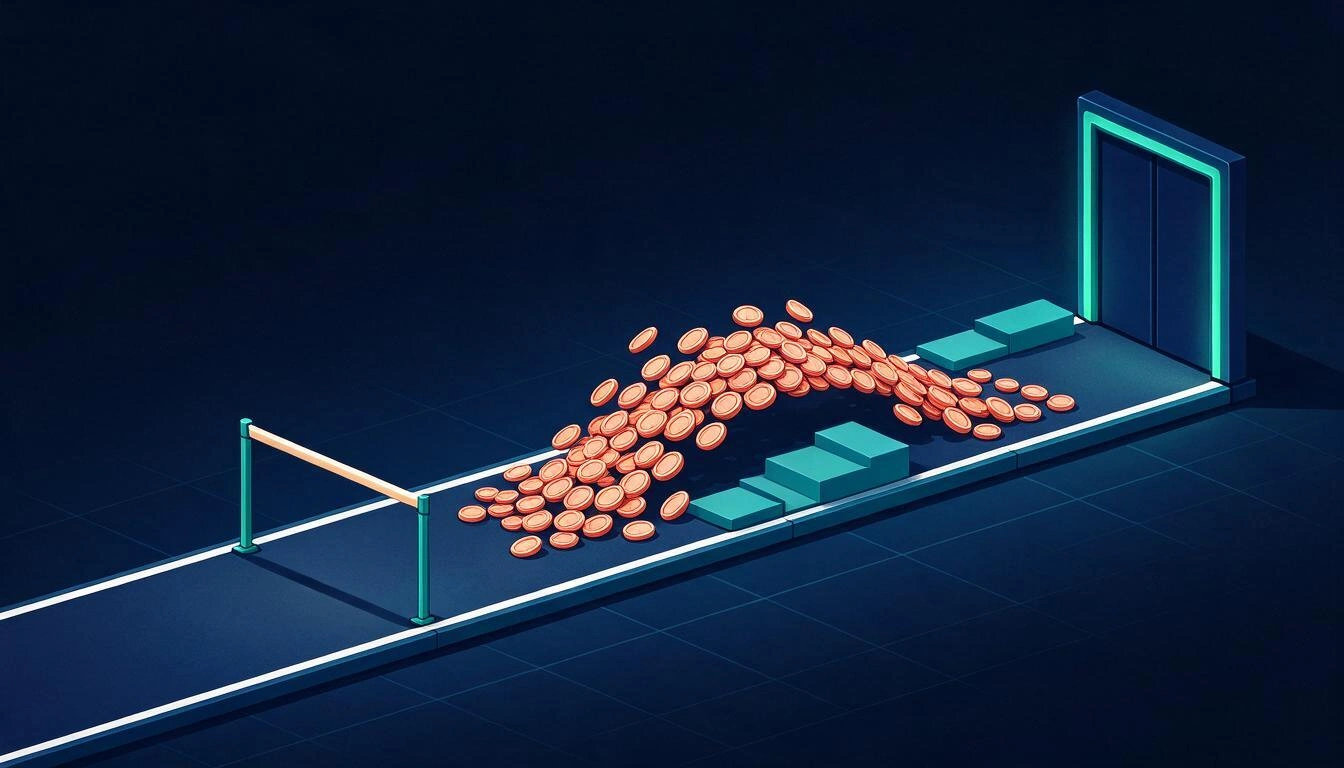
Ninety seconds is, in a runner with ~70 second runs, the first run plus the first death plus the first decision. That is the complete script you have to write by hand, second by second, before touching the engine. The sector reference for the hook is tough: "10-second hook, no tutorial wall" —the game must be readable in two seconds in an ad video— and the meta layer should not appear before sessions 3-5 (Game Growth Advisor, April 2026).
| Segment | What happens | What DOES NOT happen |
|---|---|---|
| 0-10 s | A single mechanic, a single obstacle of the easiest type (jumping). Speed already noticeably increasing | Modal tutorial, text, second mechanic |
| 10-40 s | First cluster of coins placed on the optimal line, not outside it. The second type of obstacle enters | First unknown powerup, scene change |
| 40-70 s | First combination of two obstacles. First expected death | Speed peak, two-lane obstacle |
| 70-80 s | Death screen with the coin counter and the exact distance to the first unlockable | Interstitial before showing progress |
| 80-90 s | Offer to continue or double coins with rewarded video, and one-tap restart button | Season pass, full shop, registration |
Two details that almost all prototypes skip. The first: at second 70 the player must be able to see how much is left for their first purchase; if the number is "38 runs", you just communicated that they will not get it. The second: the interstitial never goes before the progress marker, because progress is what buys the next run and the next run is what pays the interstitial.
How much should the first unlockable cost? Between one and two runs
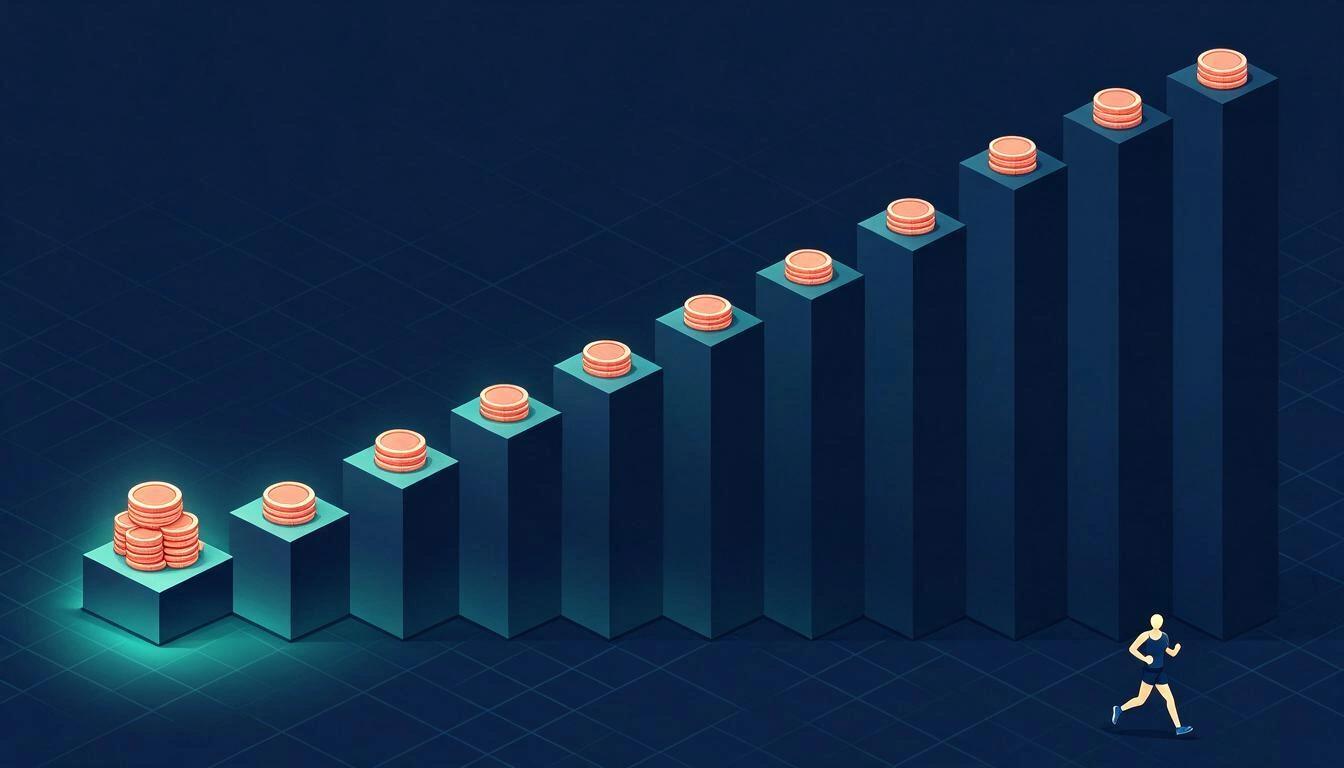
The first unlockable should cost what the player collects in one or two runs: with an average of 130 coins per run, between 130 and 260 coins. It is not an aesthetic figure: it is the only one that fits within the 63% window, because it ensures that the player closes the loop "play → collect → buy → want the next one" within the first session, which is where the money is.
The typical mistake is not setting the first price wrong, it is deriving it from the curve. If you choose a catalog of 10 unlockables with a multiplier of x1.75 and anchor the price of the last one to something aspirational, the first one comes out astronomical. What happens with 130 coins per run and 70 second runs:
| Price of 1st unlockable | Runs needed | Playtime | Verdict |
|---|---|---|---|
| 130 coins | 1 | 1.2 min | Healthy: closes the loop in the first session |
| 260 coins | 2 | 2.3 min | Healthy: recommended target |
| 500 coins | 4 | 4.7 min | Tense: already asks for a second session in many profiles |
| 1,000 coins | 8 | 9.3 min | Tense: outside the typical first session (3-6 min) |
| 2,500 coins | 20 | 23 min | Wall |
| 5,000 coins | 39 | 45 min | Wall: the average player never sees it |
And the multiplier is what decides whether the entire catalog is a game or a punishment. Starting from the healthy price of 260 coins and with 10 unlockables:
| Multiplier | Price of 10th | Full catalog | Runs for the catalog | Hours of play |
|---|---|---|---|---|
| x1.25 (soft) | 1,937 | 8,646 | 67 | 1.3 h |
| x1.45 (standard) | 7,366 | 23,160 | 178 | 3.5 h |
| x1.75 (aggressive) | 40,014 | 93,041 | 716 | 13.9 h |
| x2.10 (wall) | 206,518 | 394,004 | 3,031 | 58.9 h |
The two middle figures are defensible for a runner that wants longevity without breaking day 1. The x2.10 is not a progression curve, it is an invitation to buy coins — which can be exactly what you are looking for, but then the price in euros of the package has to be on screen before the player makes that mental division. As a market reference, the typical starter pack of hybrid-casual is around 1-3 $ and the season pass around 8-20 $, unlocking between D3 and D7 (Game Growth Advisor, 2026).
Why does a linear ramp break the runner and a logarithmic one does not?
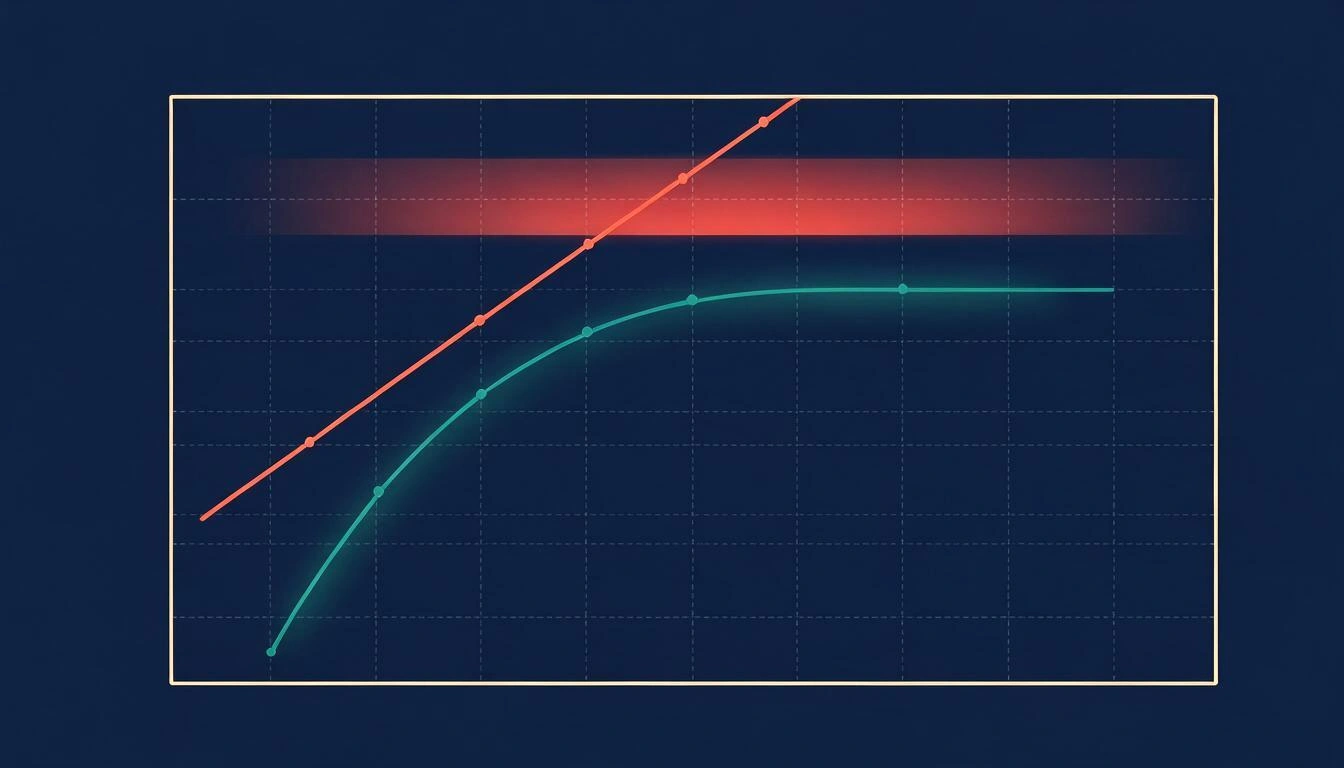
Because a linear ramp has no ceiling and a logarithmic one does. With speed v(t) = v0 + k·t there is always a moment when the reaction window falls below the human physiological limit; with a saturated ramp, v(t) = vmax − (vmax − v0)·e^(−t/τ), the speed converges to vmax and the window converges to a value you choose. The difference is not one of sensation: it is one of the existence of a failure.
The limit is measurable. The study Factors influencing the latency of simple reaction time (Woods et al., Frontiers in Human Neuroscience, 2015) reports average simple reaction times of 231 ms and 238 ms in its two experiments (about 213-220 ms once the hardware delay is corrected). That is simple reaction: one stimulus, one response. In a runner, the player also has to identify the obstacle and choose between three responses, so 250 ms is a generous floor, not strict.
Let's put the model with concrete and verifiable numbers. Suppose a vertical lane where the obstacle becomes legible (type and lane are distinguishable) in the last 9 units before the player. The reaction window is then 9 / v. The floor of 250 ms crosses at 36 u/s.
| Second | Linear ramp (9 u/s, +0.25 u/s²) | Window | Logarithmic ramp (vmax 30, τ 40 s) | Window |
|---|---|---|---|---|
| 0 s | 9.0 u/s | 1,000 ms | 9.0 u/s | 1,000 ms |
| 15 s | 12.8 u/s | 706 ms | 15.6 u/s | 578 ms |
| 30 s | 16.5 u/s | 545 ms | 20.1 u/s | 448 ms |
| 60 s | 24.0 u/s | 375 ms | 25.3 u/s | 356 ms |
| 90 s | 31.5 u/s | 286 ms | 27.8 u/s | 324 ms |
| 108 s | 36.0 u/s | 250 ms — floor | 28.6 u/s | 315 ms |
| 180 s | 54.0 u/s | 167 ms — impossible | 29.8 u/s | 302 ms |
| ∞ | no ceiling | → 0 ms | 30.0 u/s | 300 ms |
Pay attention to what the table says and not to what intuition says. In the first 30 seconds the logarithmic ramp is more aggressive than the linear one (20.1 vs. 16.5 u/s): it rises twice as fast at the start, dv/dt = (vmax − v0)/τ = 0.525 u/s² against 0.25. That is just what you want for the 10-second hook, because the sensation of acceleration is immediate. And after the minute, it flattens out and never drops below 300 ms, so a ten-minute game remains playable.
The linear ramp does the opposite: it is lukewarm when the player needs excitement and lethal when they are already committed. At second 108 —within the first or second game of a player who endures— the game demands a reaction below their simple reaction time. Not "difficult": impossible. The player does not conclude that they are bad; they conclude that the game is broken, and they uninstall before reaching day 2.
Two practical rules that derive from this:
- Choose the ceiling first, then the shape. Set
vmaxbased on the minimum window you want to guarantee (vmax = runway_legible / minimum_window) and only then decide how to get there. With 9 legible units and a floor of 300 ms,vmax = 30 u/s. Period. - If you use steps instead of a curve, check each step separately. A stepped ramp is easy to adjust, but the failure hides in the last step: it is the only one people do not test because you have to survive to get there.
The 28-day seasons of SYBO only work if the player reaches day 2
SYBO operates Subway Surfers City with a season cadence of exactly 28 days: Season 9 started on October 7, 2026, and Season 10, "Season of Jenny", runs from November 4 to December 2, 2026 with Jenny, Wildflower, and Peace of Grind as rewards, according to the Subway Surfers City wiki. The sequel was released on February 26, 2026 (Variety), about a franchise that is the most downloaded mobile game in history.
That cadence is the perfect counterpoint to everything above: a 28-day retention machine is a huge asset… and it is completely inert for the player who leaves at second 108 of their first game. SYBO can afford a seasonal calendar because its day 1 has been solved for a decade and because it has the brand recognition that saves you the tutorial. Your prototype, does not. The correct order is: first the 90 seconds and the first unlockable, then the calendar. Otherwise, you build a season for nobody.
How to audit the two decisions before writing a line of code
The two audits are done with a spreadsheet and fifteen minutes, before opening the editor. The first is arithmetic of economics; the second is geometry of the reaction window. Neither needs the game finished, and both have a binary verdict.
Audit 1 — The first unlockable (economics)
- Measure your average coins per game in the silliest prototype you have, or estimate them: coins per cluster × clusters per game × realistic collection rate (not the designer's, who plays well).
- Divide the price of the first unlockable by that figure. If the result is greater than 3 games, it’s wrong.
- Multiply those games by the average game duration and compare it with the typical session of the genre: 3-6 minutes (Game Growth Advisor, 2026). If it doesn’t fit in a session, it’s wrong.
- Repeat the calculation for the full catalog with your multiplier. If the total exceeds ~200 games, you are not designing progression: you are designing a coin store showcase. Decide if that’s what you want and put it in writing.
Audit 2 — The speed ramp (difficulty)
- Define your readable runway in game units: the distance from when the obstacle is distinguishable until it reaches you. Measure it, don’t assume it; it depends on the camera and resolution.
- Calculate the floor:
vmax_allowed = readable_runway / 0.25 s. Any speed above this is unplayable by design. - Tabulate
v(t)every 15 seconds up to three times your average game duration and mark in red each row whose window drops below 300 ms. - If your ramp is linear, calculate the exact moment of crossing:
t = (vmax_allowed − v0) / k. If that moment is within the first 3 minutes, change the shape of the ramp, not the value of k. - Verify, furthermore, that the minimum gaps between obstacles respect the same window at maximum speed: a pattern that is valid at 15 u/s may not have a solution at 30 u/s.
The result of the two audits is a pair of numbers that fit on a post-it and should be pinned down before the first line of code: price of the first unlockable in coins, and maximum speed in units per second. If you prefer not to keep the spreadsheet, the Subway Surfers app from AiToolsForApps is designed exactly for this job: AI tools for those who create, sell, or compete in Subway Surfers, with a calculator for economy, difficulty, and runner patterns that you can use without registering.
Frequently Asked Questions
How much should the first unlockable item cost in my endless runner?
What the player collects in one or two games. With 130 coins per game, between 130 and 260 coins. The criterion is not the absolute price but the number of games: if it exceeds three, the average player will not close the purchase loop in their first session, and with 63% of advertising revenue concentrated on day 1 (AppsFlyer, 2026) that is money you won't see.
What multiplier should I use for the price curve of unlockables?
Between x1.25 and x1.45 for a catalog of 10 items if you want it to be completable by playing (67 to 178 games, 1.3 to 3.5 hours). At x1.75 the catalog goes to 716 games and at x2.10 to over 3,000: from there, you are not selling progression, you are selling coins, and it is advisable to assume this explicitly in the store design.
Why does my runner become unplayable after a minute and a half?
Almost always because the speed ramp is linear. A linear ramp grows without a ceiling, so there always comes a second when the window to see, decide, and act falls below human reaction time. With a start of 9 u/s, +0.25 u/s² and 9 readable runway units, that moment is second 108. Calculate your own crossing with t = (runway / 0.25 − v0) / k.
What is the human reaction time I should respect in a reflex game?
Use 250 ms as an absolute floor and 300 ms as a design goal. The simple reaction time measured in the lab is 231-238 ms (Woods et al., 2015), and that is for one stimulus and one response; in a runner, you have to identify the obstacle and choose between several lanes, which adds decision latency and tactile input latency.
Should an endless runner monetize with ads or in-app purchases?
With both, but in that order. 79% of hyper-casual monetizes only with ads (AppsFlyer, 2026), and industry sources place the typical breakdown at 90-95% ads versus 5-10% IAP. At the same time, hybrid-casual IAP grew by 20% to $4.2 billion in 2025 (Sensor Tower), so the purchase layer —starter pack of $1-3, pass of $8-20— is what gives you a ceiling. Ads pay on day 1; IAP pays the rest.
How many rewarded videos do I need to recover the cost of an installation?
With a combined CPI of $0.56 (Adjust, 2026) and a rewarded eCPM of $15, about 37 impressions over the entire user lifetime, of which ~23 on the first day if your curve resembles that of the average hyper-casual. Recalculate with your actual eCPM: the range cited for rewarded is broad, $10-50 per thousand impressions.
How often should I rotate the seasons of my runner?
The living reference of the genre is the 28 days that SYBO maintains in Subway Surfers City (Season 10, from November 4 to December 2, 2026). But that calendar is a phase 2 decision: it only pays off when day 1 is already working, because only those who return see a season. With a D7 of 10% in the genre, you are designing seasonal content for one-tenth of your installations.
Conclusion: two numbers before the first commit
If 63% of your runner's advertising revenue comes in on day 1, the most profitable design work you can do this week is not a new world: it is writing the script for the first 90 seconds, placing the first unlockable two games away, and changing the linear ramp for a saturated one with a chosen ceiling. These are two numbers —coins of the first price and maximum speed in u/s— and both are audited with a spreadsheet before writing code.
To do it without setting up the spreadsheet, Subway Surfers is the AiToolsForApps app with AI tools for those who create, sell, or compete in Subway Surfers: check out the economy, difficulty, and patterns tools to design a runner and test your numbers without registering.
Put your numbers to the test before writing code: calculate the price of the first unlockable in games and check if your speed ramp crosses the 250 ms reaction floor. Try Subway Surfers' AI tools without signing up.
Put your numbers to the test before writing code: calculate the price of the first unlockable in games and check if your speed ramp crosses the 250 ms reaction floor. Try Subway Surfers' AI tools without signing up.Keep reading
View all articles →
Subway Surfers City swaps the World Tour for a permanent map: how to redesign the progression and economy of your endless runner

Broken Geode in Geometry Dash 2.2091: which mods are not working and how to keep creating

DLS 27 in December 2026: what is confirmed, what is not, and what happens to your club, your squad and your kits when you update